A free guide from Comply
NPSG.15.01.01: suicide risk reduction in behavioral health, element by element
The Joint Commission's suicide prevention goal has seven elements of performance. Here is what each one asks of an outpatient, IOP, PHP or residential program, the evidence a surveyor looks for, a worked example of one positive screen from first question to follow-up call, and the measures that prove it all works.
Updated October 27, 2026, against the Joint Commission's National Patient Safety Goals effective January 2026 for behavioral health care and human services. The standards text is licensed, so this guide paraphrases and links; read the exact wording in your own manual.
The short answer: NPSG.15.01.01, "Reduce the risk for suicide," applies to every Joint Commission-accredited behavioral health care organization. Its seven elements of performance (EPs) ask you to (1) assess the environment for things that could be used in a suicide attempt, (2) screen every individual served for suicidal ideation with a validated tool, (3) use an evidence-based process to assess anyone who screens positive, (4) document their overall level of risk and the plan to mitigate it, (5) follow written procedures for staff training and competence, reassessment and monitoring of high-risk individuals, (6) follow written procedures for counseling and follow-up at discharge, and (7) monitor whether all of it is working and fix what isn't. Surveyors check it in the chart, in staff interviews and in your performance improvement data.
What NPSG.15.01.01 is, and who it applies to
The Joint Commission rewrote its suicide prevention goal in its R3 Report Issue 18, effective July 1, 2019, for accredited hospitals and behavioral health care organizations. The earlier version had three elements of performance; the revision has seven, and the R3 Report explains the reasoning behind each one with references. The 2026 National Patient Safety Goals for behavioral health care and human services still carry NPSG.15.01.01.
The behavioral health version is broader than the hospital one. A hospital screens patients whose main reason for care is a behavioral health condition; a behavioral health program screens all individuals served, because behavioral health care is the reason everyone is there. The goal applies at every level of care you're accredited for: outpatient, intensive outpatient, partial hospitalization, day treatment and residential. Only EP 1's environmental standard changes by setting: non-inpatient settings and unlocked units don't have to be ligature resistant (see the ligature risk assessment guide).
In January 2026 the Joint Commission replaced the National Patient Safety Goals with National Performance Goals for hospitals and critical access hospitals. As of this update, the behavioral health care and human services program still uses the NPSG chapter. Check which chapter your current manual has.
The seven elements of performance at a glance
Paraphrased from the 2026 behavioral health NPSG chapter and the R3 Report. The "evidence" column is what we keep ready for a surveyor at a licensed Texas outpatient program we run; the Joint Commission doesn't prescribe forms.
| EP | What it asks | Evidence a surveyor can see |
|---|---|---|
| 1. Environment | Assess the physical environment for features that could be used to attempt suicide, and act to reduce the risk. | A room-by-room assessment with each risk and how it's fixed or managed, approved by leadership, redone yearly and after changes. |
| 2. Screening | Screen all individuals served for suicidal ideation using a validated screening tool. | The tool named in policy; a completed, dated screen in every chart, done at the point your policy sets. |
| 3. Assessment | Use an evidence-based process to assess the suicide risk of anyone who screens positive. | The assessment in the chart, asking directly about ideation, plan, intent, suicidal or self-harm behavior, risk factors and protective factors. |
| 4. Documentation | Document the individual's overall level of risk and the plan to mitigate it. | A stated risk level (for example low, moderate or high), how it was reached, and a safety plan or other mitigation every clinician can find. |
| 5. Policies | Follow written procedures for people at risk, covering at least staff training and competence assessment, reassessment, and monitoring of people at high risk. | The policy; training records and competency checks in personnel files; reassessments in the chart; what staff say when asked "what do you do if…". |
| 6. Discharge | Follow written procedures for counseling and follow-up care at discharge for people identified as at risk. | The discharge safety plan, crisis numbers given, lethal means counseling, and the follow-up appointment or contact documented. |
| 7. Monitoring | Monitor how well the screening, assessment and management procedures are carried out and how well they work, and act to improve. | Chart audit results for the suicide measures, trended by quarter, with the changes you made in the quality minutes. |
EP 2: suicide risk screening with a validated tool
"Validated" means the instrument has been tested for reliability and validity in the population you serve. The Joint Commission's behavioral health screening FAQ gives examples, including the ASQ Suicide Risk Screening Tool, the PHQ-9, the Patient Safety Screener, the ED-SAFE secondary screener and the TASR adolescent screener, and notes that the Columbia-Suicide Severity Rating Scale can be used both to screen and to assess. Two free, widely used options:
- The C-SSRS screener from the Columbia Lighthouse Project, which publishes setting-specific versions (outpatient, "since last contact," children) with triage guidance and free training.
- The ASQ from the National Institute of Mental Health: four questions, about 20 seconds, validated for youth and adult medical patients, with outpatient pathways and a brief suicide safety assessment for positive screens.
Use the tool exactly as written. The Joint Commission's Quick Safety Issue 68 (March 2023) warns that small changes to a validated tool's wording can change its accuracy, and that staff need training on the tool and on what happens after a positive answer.
When to screen
The EP doesn't set an interval; your policy does, and surveyors will hold you to it. The points we screen at, and that we'd defend in a tracer:
- The pre-admission screen, by phone or in person. A positive safety answer goes to a licensed clinician the same day.
- Intake, before the first clinical service.
- Any change: a disclosure in group, a return to use, a loss, a court date, a missed day followed by a worrying call, a step up or down in level of care.
- Discharge, including an unplanned one (EP 6).
- A recurring point you choose for clients already identified as at risk, such as each individual session or each program week, using the tool's "since last contact" version.
EP 3: the suicide risk assessment
A positive screen starts the assessment, done by a clinician your policy says is qualified, the same day. The Joint Commission's FAQ on an evidence-based assessment process and the R3 Report say the assessment asks directly about suicidal ideation, plan, intent, suicidal or self-harm behavior, risk factors and protective factors, and that how the level of risk was decided is documented. One instrument can do both jobs: the FAQ says EPs 2 and 3 can be met by a single process that screens for ideation and assesses its severity at the same time.
Common frameworks: the full C-SSRS with its risk and protective factor checklist, and SAMHSA's SAFE-T pocket card (identify risk factors, identify protective factors, conduct the suicide inquiry, determine risk level and intervention, document). In a substance use program, add what's specific to your clients: recent use and intoxication, withdrawal, overdose history (intentional or not), access to opioids and other lethal means, and recent losses such as a job, a relationship or custody.
If anyone is in immediate danger, the assessment stops being the priority. Staff call 911 or connect the person to the 988 Suicide and Crisis Lifeline and stay with them until help takes over. In Texas, every county's local mental health or behavioral health authority runs a 24-hour crisis line and mobile crisis outreach; put your county's number in the procedure.
EP 4: level of risk and the safety plan
EP 4 asks for two things in the record: the individual's overall level of risk and the plan to mitigate it. The R3 Report's rationale is that every clinician who might work with the person needs to see both. In practice, a risk level buried in an intake narrative fails that test; put it where the next clinician looks first (a flag, the problem list, the top of the note).
For moderate and high risk, the mitigation plan usually includes a written safety plan built with the client. The VA's safety plan worksheet uses six steps, and it's a good model for any program:
- Warning signs: the thoughts, moods and situations that come before a crisis.
- Coping strategies the person can use alone.
- People and social settings that help take their mind off things.
- People they can ask for help, with phone numbers.
- Professionals and agencies to contact in a crisis, including 988 and the program's own number.
- Making the environment safe: reducing access to firearms, stockpiled medications and other lethal means. For clients who use opioids, include naloxone.
The plan changes the treatment plan too: a safety problem with objectives, more frequent contact, family involvement with the client's consent (and a 42 CFR Part 2 consent for a substance use program), or a referral to a higher level of care.
EP 5: training, reassessment and monitoring
EP 5 asks for written policies and procedures for the care of individuals at risk, and names three things they must cover at minimum:
- Training and competence assessment of the staff who care for people at risk. Training on the screening tool alone isn't enough: staff need to know what to do after a positive answer. The EP sets no interval; we train clinical staff at hire and yearly, and keep the certificate or a signed competency check in each personnel file.
- Guidelines for reassessment: when an at-risk client is screened or assessed again, and by whom.
- Monitoring of individuals at high risk: in a residential program, observation levels; in an outpatient building, who stays with the person, restroom access, clearing the room of items, and when the program calls 911, mobile crisis or arranges a higher level of care. Write the outpatient version for the building you actually have.
Surveyors test EP 5 by asking staff. A front-desk employee should be able to say what they do when a client says something alarming in the waiting room; a counselor should be able to name the tool, the cut-off and the next step.
EP 6: counseling and follow-up at discharge
The R3 Report explains why this EP exists: the risk of suicide is high in the period after someone leaves psychiatric inpatient or emergency care, and a safety plan plus crisis line numbers can reduce suicidal behavior after the person leaves. For anyone identified as at risk, the discharge procedure should cover:
- A rescreen on the last day, including an unplanned last day (a client who stops coming gets a call and a documented attempt).
- The safety plan reviewed and updated, with a copy to the client.
- Crisis resources in writing: 988, your county's crisis line, the program's number.
- Lethal means counseling with the client and, with consent, the family.
- A dated next appointment with the receiving provider, not just a name and phone number, and the handoff documented.
- A follow-up contact after discharge on the timeline your policy sets for at-risk clients.
The Joint Commission's suicide risk reduction resources collect examples of discharge practices from accredited organizations.
EP 7: measuring whether it works
EP 7 is the one programs forget: monitor whether the procedures are followed and whether they work, then act. Pull a sample of charts each quarter (the chart audit checklist has the lines) and trend these:
| Measure | Numerator / denominator | What a low number usually means |
|---|---|---|
| Screened at intake | Charts with a validated screen before the first clinical service / charts reviewed | The screen lives on paper or in a form nobody is prompted to open. |
| Same-day assessment | Positive screens assessed the same day / positive screens | No licensed clinician on site at intake times, or no clear handoff. |
| Risk level and plan documented | Assessed clients with a stated risk level and a mitigation plan / assessed clients | The assessment form has no risk-level field, or the safety plan is optional. |
| Reassessed when due | At-risk clients reassessed on the policy's schedule / at-risk clients | Nothing reminds the clinician. |
| Discharge safety steps | At-risk discharges with rescreen, safety plan, crisis numbers and follow-up / at-risk discharges | Unplanned discharges are never closed out. |
| Staff trained | Clinical staff with current training and competency / clinical staff | New hires start seeing clients before training. |
Report the results to the quality committee with what you changed. A suicide or a serious suicide attempt connected to your care also goes through the sentinel event process: see sentinel events and root cause analysis and, for the state's reporting clocks, incident reporting timelines.
A worked example: one positive screen
A made-up client and made-up times, to show how the EPs connect in an intensive outpatient program.
| When | What happens | EP |
|---|---|---|
| Monday 9:10 | Client 1047 completes the intake screen on a tablet and answers yes to "thoughts of killing yourself" in the past month. The intake coordinator pauses intake and walks the client to the clinical director's office. | 2, 5 |
| 9:20 | An LPC completes the full C-SSRS: thoughts of a method but no intent to act and no plan, no attempt in the past three months, a prior overdose two years ago, lives with a partner, has a sister she trusts, pills left from a dental procedure at home. | 3 |
| 9:50 | Risk documented as moderate, with the reasons. Safety plan built with the client: warning signs, coping steps, her sister's number, 988, the program's number; she agrees to let her sister hold the pills, and takes naloxone home. | 4 |
| 10:15 | She joins group. The risk flag is visible to the group facilitator, who checks in at the break. Treatment plan gets a safety problem and a weekly reassessment. | 4, 5 |
| Each Monday | "Since last contact" C-SSRS in her individual session; risk lowered to low in week three, with the reason. | 5 |
| Week six | Planned discharge: rescreen negative, safety plan updated and copied to her, crisis numbers given, outpatient counseling booked for the following Tuesday with the receiving counselor's name. | 6 |
| Next quarter | Her chart is in the audit sample; all six measures met. The quarter's one miss (an unplanned discharge with no follow-up call) leads to a change: the clinical director's Friday list now includes every client absent three days in a row. | 7 |
Texas rules that sit next to it
- No standalone instrument rule. 26 TAC 564 doesn't name a suicide screening tool for chemical dependency treatment facilities; it sits inside the assessment and the mental health referral duty, as our sister site's 26 TAC 564 requirements guide explains. An accredited program follows NPSG.15.01.01 on top.
- Suicide attempts are reportable incidents. A suicide attempt by an active client, on or off site, needs an internal incident report within 24 hours (26 TAC 564.509).
- No restraint or seclusion in outpatient programs, except as it relates to court-committed clients (564.706(b)), so the high-risk monitoring procedure relies on staying with the person, de-escalation and outside help. Direct-care staff need 4 hours of nonviolent crisis intervention training, then 2 hours a year (564.603).
- The license's follow-up contact is a different clock. 564.805(j) asks for one contact between day 60 and day 90 after discharge for every client. An at-risk client's follow-up under EP 6 should come much sooner.
Where Comply and Cima EHR fit
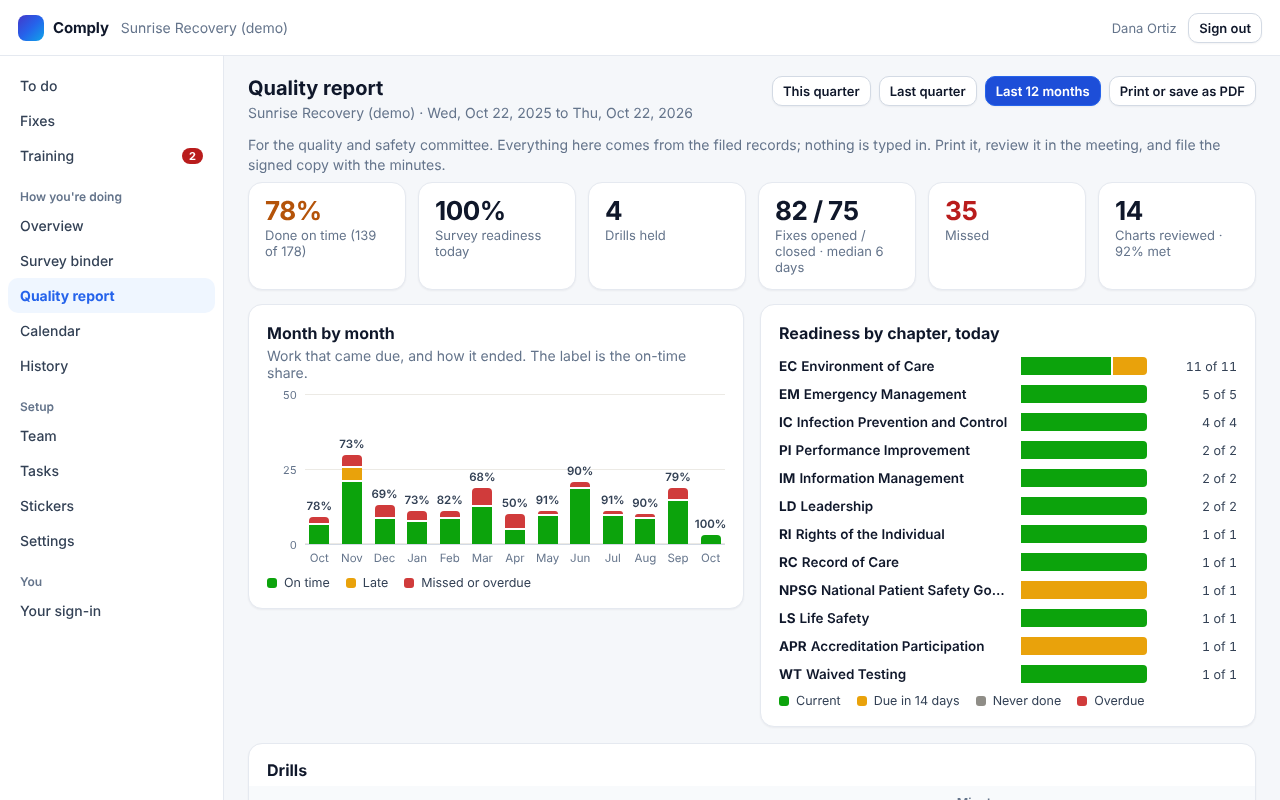
Comply doesn't hold client information, so the screens and safety plans stay in your clinical record. What Comply does is keep the program side of NPSG.15.01.01 on schedule: suicide risk screening training is a yearly requirement for every clinical staff member, with the certificate or competency check stored as proof; the environmental suicide risk assessment is a yearly task for each building; the quarterly chart review includes the suicide screen at admission and a safety plan wherever risk was found; and the quarterly incident review asks whether any sentinel event had a root cause analysis. Every result is filed under National Patient Safety Goals in the survey binder. The full year is in the compliance calendar.
On the clinical side, Cima EHR's screenings put a red safety card on the clinician's Today screen and send an email when a client answers above "Not at all" on the PHQ-9's self-harm question, and a note with moderate or high risk can't be signed without a safety plan.
Show a surveyor all seven EPs, not just the ligature walk
Comply schedules the training, the environmental assessment, the chart review and the incident review, and keeps the proof in one binder. Book a 20-minute walkthrough.
Writing the policy from scratch? Cima Consulting's program policy and procedure manual ($7,500) includes the suicide risk screening and reduction policy, and a mock survey ($6,500) traces it the way a surveyor would.
Questions
What is NPSG.15.01.01?
It's the Joint Commission's National Patient Safety Goal "Reduce the risk for suicide." For behavioral health care organizations it has seven elements of performance: an environmental risk assessment, screening everyone served with a validated tool, an evidence-based assessment of positive screens, documenting the level of risk and the plan, written procedures for training, reassessment and monitoring, procedures for discharge counseling and follow-up, and monitoring how well it all works.
Does NPSG.15.01.01 apply to outpatient and IOP programs?
Yes. It applies to accredited behavioral health care organizations at every level of care. What differs for outpatient, IOP, PHP and residential settings is the environment: they must assess environmental risk but don't have to be ligature resistant.
Which suicide screening tools does the Joint Commission accept?
It doesn't publish an approved list; the tool must be validated. Its FAQ gives examples including the ASQ, the PHQ-9, the Patient Safety Screener, the ED-SAFE secondary screener and the TASR adolescent screener, and says the C-SSRS can be used for both screening and assessment. Use the tool as written; changing the wording can change its accuracy.
How often do we have to screen for suicide risk?
The element of performance doesn't set a frequency. Your written policy does, and surveyors check that you follow it. Most programs screen at pre-admission or intake, at any significant change, on a recurring schedule for clients already at risk, and at discharge.
Does every positive screen need a safety plan?
Every positive screen needs an assessment (EP 3) and a documented level of risk with a plan to mitigate it (EP 4). For moderate or high risk, that plan is usually a written safety plan built with the client. Your policy should say which risk levels require one.
What training does NPSG.15.01.01 require?
EP 5 requires written procedures that include training and competence assessment for staff who care for individuals at risk for suicide. It doesn't set an interval. Train on the tool, the assessment, the safety plan and the emergency steps at hire, then on the schedule your policy sets (yearly is common), and keep proof in each personnel file.
Is NPSG.15.01.01 being replaced by National Performance Goals?
For hospitals and critical access hospitals, the National Performance Goals replaced the NPSG chapter in January 2026. As of October 2026, the behavioral health care and human services program still uses the National Patient Safety Goals, including NPSG.15.01.01.
More in this set: the ligature risk assessment (EP 1 in depth), sentinel events and root cause analysis, incident reporting timelines, the chart audit checklist and the Joint Commission checklist.
Sources
- The Joint Commission, R3 Report Issue 18: National Patient Safety Goal for suicide prevention (effective July 1, 2019; requirements, rationale and references for each EP).
- The Joint Commission, National Patient Safety Goals effective January 2026, Behavioral Health Care and Human Services; National Performance Goals.
- The Joint Commission, standards FAQs: screening requirements (BHC); use of an evidence-based process to assess risk; environmental risk assessments in non-inpatient settings.
- The Joint Commission, Quick Safety Issue 68: Utilizing validated tools for suicide risk screening (March 2023); Resources for suicide risk reduction.
- National Institute of Mental Health, Ask Suicide-Screening Questions (ASQ) Toolkit; The Columbia Lighthouse Project, C-SSRS.
- SAMHSA, SAFE-T pocket card (SMA09-4432); U.S. Department of Veterans Affairs, safety plan worksheet.
- Texas HHSC, mental health crisis services; 26 Tex. Admin. Code chapter 564 (564.509, 564.603, 564.706, 564.805); 988 Suicide and Crisis Lifeline.
The example is made up. This guide is general information, not clinical or legal advice; the official standards text controls. Comply isn't affiliated with or endorsed by The Joint Commission, NIMH, SAMHSA, the VA or Columbia University.
Seven elements, one binder.
See how Comply keeps the training, the environmental assessment and the chart reviews behind NPSG.15.01.01 on schedule.
Book a walkthrough