A free guide from Comply
Joint Commission survey checklist for behavioral health programs
Chapter by chapter: what surveyors look at in an outpatient or residential behavioral health program, the recurring work behind each chapter, and the records to have ready on the morning they arrive.
Updated October 24, 2026. Standard numbers are cited so you can find them in your own manual; check the current edition, because the Joint Commission revises it during the year.
How a behavioral health survey works
The Joint Commission's survey activity guide for behavioral health care and human services says surveyors arrive unannounced or with short notice for most surveys. So "survey-ready" has to mean every week, not the month you expect them.
The heart of the visit is the tracer. Surveyors pick people from your list of individuals currently served and follow each one's care through the program: they read the record, then talk with the staff who worked with that person. What they find in one record leads them to the next question.
Between surveys, accredited programs also do a yearly self-assessment against the standards (the Focused Standards Assessment) and write plans of action for the gaps.
Comply isn't affiliated with or endorsed by The Joint Commission. The standards text is licensed, so this guide cites numbers only. Your state's licensing rules (in Texas, 26 TAC 564 for chemical dependency treatment facilities) apply on top, and where your own policy says something stricter, surveyors hold you to your policy.
What a tracer pulls in
One person's record is the thread. Expect it to lead to:
- The record itself: consent, assessment, an individualized plan, notes tied to the plan's goals, signatures, screenings and, if discharged, the summary. (The chart audit checklist walks through each item.)
- The staff who served them: their license, orientation, training and competence, from the personnel file.
- The rooms they used: exits, ligature risks, postings, cleanliness, the naloxone kit.
- Your systems: how you'd evacuate them, how you track incidents and grievances, and what your quality committee did with the data.
Staff are asked questions directly ("What do you do if the fire alarm goes off?"), so training shows up in their answers, not just in the binder.
The checklist, by chapter
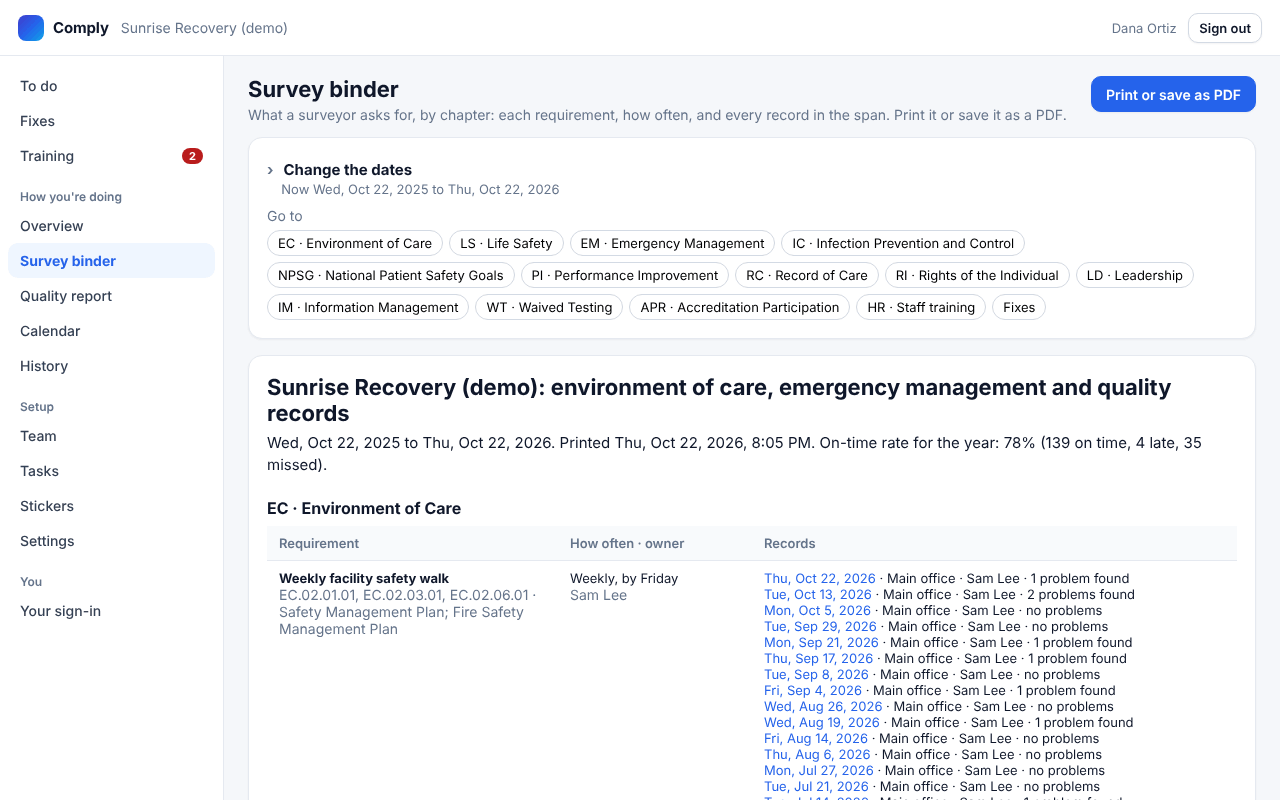
Each line is recurring work with the evidence a surveyor asks to see and the standards it maps to. Frequencies are common defaults; your policy sets yours. The full schedule is in the compliance calendar.
EC Environment of Care
Is the building safe, checked on a schedule, and are problems fixed and reported?
- Facility safety walkWeekly Dated walk with initials; fixes for anything found.EC.02.01.01, EC.02.03.01, EC.02.06.01
- Fire extinguisher inspectionMonthly Initialed, dated tag on each extinguisher and a record listing each one.EC.02.03.05
- Emergency lights and exit signs, 30-second testMonthly Each light tested and the result.EC.02.05.07, LS.02.01.20
- Environment of care roundsMonthly Fire safety, security, hazardous materials, infection control and equipment, with photos and closed fixes.EC.04.01.01, EC.02.01.01, EC.02.02.01, EC.02.06.01
- Naloxone, AED and first aid kit checkMonthly Expiration dates and restock receipts.EC.02.04.03, EM.12.01.01
- Program vehicle inspectionMonthly, if you transport clients One per vehicle; registration and insurance current.EC.02.01.01
- Fire drillBy occupancy Date, time, shift, scenario, evacuation time, who took part, sign-in sheet, critique and fixes. See fire drill requirements.EC.02.03.03
- Smoke detectors, egress lights and outletsQuarterly The checks staff can do themselves; the alarm vendor services the system yearly.EC.02.03.05, EC.02.05.01
- Environment of care report to the quality committeeQuarterly Minutes showing rounds, drills, incidents and fixes were reviewed.EC.04.01.01, PI.02.01.01
- Annual evaluation of the environment of care plansYearly Safety, security, fire safety, hazardous materials, medical equipment and utilities, each evaluated in writing.EC.04.01.01
- OSHA 300A summary postedFeb 1 to Apr 30 Photo of the posted, signed summary (employers with 10 or fewer employees are partially exempt).EC.02.01.01; 29 CFR 1904.32
EM Emergency Management
Do you know your likely emergencies, is there a current plan, and has it been tested?
- Hazard vulnerability analysisYearly Scored worksheet signed by leadership; the top hazards linked to the plan and the drills.EM.11.01.01
- Emergency Operations Plan review and approvalYearly Signed, dated approval page and a list of changes from drills and real events.EM.12.01.01, EM.17.01.01
- Emergency exerciseEvery 6 months Exercise record, sign-in sheet, after-action critique and the plan changes. Comply keeps exercises 4 to 12 months apart.EM.16.01.01, EM.17.01.01
- Evacuation maps and quick guidesQuarterly A map in every room clients use, matching the building and the plan.EM.12.01.01, EM.15.01.01
- Critical utilities assessmentYearly What happens if power, water, phones or internet go out, and the backup for each.EM.12.01.01, EC.02.05.01
IC Infection Prevention and Control
Have you ranked your infection risks, and do the rooms and the staff show it?
- Infection control roundsQuarterly Hand hygiene supplies, cleaning schedule, sharps, waste, the drug-screen area.IC.02.01.01, IC.02.02.01
- Hand hygiene observationsQuarterly Opportunities observed, times hands were cleaned, the rate shared with staff.NPSG.07.01.01, IC.01.04.01
- Infection control risk assessment, goals and exposure control planYearly Signed assessment, last year's goals evaluated, plan updated, sharps injury log reviewed.IC.01.03.01, IC.03.01.01
- Flu vaccine offered to staffEach season Who was vaccinated, with signed declinations for the rest.IC.02.04.01
- Staff TB screeningAt hire, then yearly Proof in each personnel file.IC.02.03.01; 26 TAC 564 in Texas
LS Life Safety
Are the building's fire systems inspected by the people licensed to do it, and can you prove it?
- Vendor and landlord inspection proofYearly Extinguisher service, fire alarm test, sprinkler inspection, 90-minute emergency light test, and the certificate of occupancy. If the landlord owns the systems, get copies.LS.01.01.01, EC.02.03.05, EC.02.05.07
NPSG National Patient Safety Goals
Have you looked at every room through the eyes of someone at risk of self-harm?
- Environmental suicide risk (ligature) assessmentYearly Room by room, the risks found and how each is fixed or managed, approved by leadership.NPSG.15.01.01
- Suicide risk screening training for clinical staffYearly Certificate or signed competency check for the screening tool you use.NPSG.15.01.01, HR.01.06.01
In 2026 the Joint Commission began replacing the National Patient Safety Goals with National Performance Goals, starting with hospitals. Check which chapter your program's current manual uses.
PI Performance Improvement
Do you collect data, look at it, and change something because of it?
- Incident, grievance and complaint reviewQuarterly Counts, trends and what changed; the grievance log with response dates; a root cause analysis for any sentinel event.PI.02.01.01, RI.01.07.01, LD.03.09.01
- Client satisfaction and outcomesQuarterly Survey counts and scores, a standardized outcome measure scored at set points, and what you did about it.CTS.03.01.09, PI.01.01.01
RC Record of Care
Does the record show the care, on time, signed, and reviewed by the program itself?
- Clinical record reviewQuarterly The sample, each chart's review by chart number, the score and the corrective actions, reported to staff and the quality committee. Use the checklist.RC.01.01.01, RC.02.01.01, PI.01.01.01
RI Rights of the Individual
Can clients see their rights and how to complain, and do staff know them?
- Required postings checkMonthly Client rights, grievance steps with the state agency's number, the accreditor's public notice, the state license, abuse reporting number, labor postings.RI.01.01.01, APR.09.01.01
- Client rights and grievances trainingYearly Certificate or signed sign-in sheet for every staff member.RI.01.01.01
- Abuse, neglect and exploitation reporting trainingYearly Staff know how, to whom and by when.RI.01.06.03
LD Leadership
Does leadership review the program, its policies and its contracts on a schedule?
- Policy and procedure manual reviewYearly Review date and approver on each policy, a change log, and staff sign-off on changes.LD.04.01.07
- Annual program evaluationYearly Quality, outcomes, staffing, budget and contracted services reviewed; next year's goals set; the minutes where leadership approved it.LD.03.01.01, PI.03.01.01
IM Information Management
Do you know where client information lives, and could you handle a breach?
- HIPAA security risk analysisYearly Signed analysis with a risk management plan, business associate agreements on file, a test restore of the backups.IM.02.01.03; 45 CFR 164.308
- Privacy breach tabletopEvery 6 months Scenario, decisions, notice deadlines, 42 CFR Part 2 rules, gaps and fixes.IM.02.01.03
HR Human Resources
Is everyone who works with clients qualified, oriented, trained and competent, with proof in the file?
- License or certification verified at the sourceAt hire and each renewal A printout from the licensing board's site showing it's active, with the number and expiry.HR.01.01.01
- Background and exclusion checksBefore hire; exclusion lists monthly The date the criminal history check cleared and who reviewed it; OIG, SAM and state exclusion searches.HR.01.01.01; 42 CFR 1001.1901
- New-hire orientationWithin 14 days of hire The signed orientation checklist.HR.01.04.01
- Yearly trainingYearly Privacy (HIPAA and Part 2), bloodborne pathogens, fire safety and emergency procedures, client rights, abuse reporting, cultural competency, and the clinical topics for clinical staff.HR.01.05.03; OSHA 1910.1030
- Competence: CPR and first aid, de-escalation, naloxone, medication handlingBy the card's date or yearly A copy of each card or a signed hands-on check.HR.01.06.01
MM Medication Management
If medication is kept on site, is it locked, in range and logged?
- Medication refrigerator and storage logMonthly review of daily readings The temperature log, out-of-range readings acted on, storage locked, nothing expired.MM.03.01.01
WT Waived Testing
If you do point-of-care drug screens, is the certificate current and are testers competent?
- CLIA certificate of waiverEvery 2 years The current certificate on file and posted.WT.01.01.01
- Testing staff competencyAt hire, then yearly A signed competency check for each person who runs the tests.WT.01.01.01
APR Accreditation Participation
- Focused Standards AssessmentYearly The submitted self-assessment and the plans of action for gaps.APR chapter
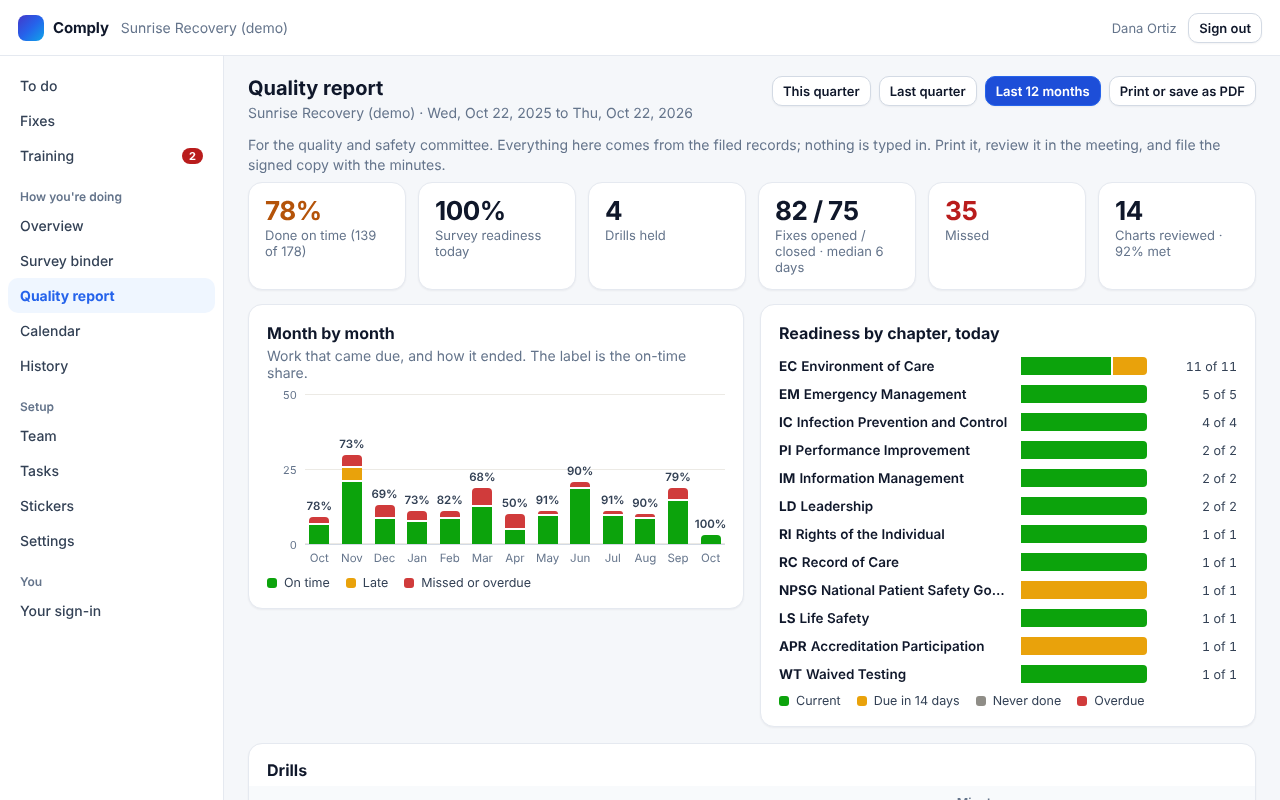
Records to have ready on day one
When surveyors arrive, the first hour goes better if these are in one place:
- A current list of individuals served, with level of care, so tracers can be picked.
- The policy and procedure manual, with this year's review and approval dates.
- The hazard vulnerability analysis and the signed Emergency Operations Plan.
- Twelve months of fire drills and emergency exercises, each with its sign-in sheet and critique.
- Environment of care rounds, inspection records and the vendor reports, by month.
- Quality committee minutes, the incident and grievance log, and the record review results with their fixes.
- Personnel files: licenses verified, background checks, orientation, training and cards.
- Certificates: state license, CLIA certificate of waiver, certificate of occupancy.
If the survey could be soon
Don't try to fix everything at once. Start with what carries the most risk and is easiest to prove:
- Life safety first: a fire drill with a written critique, environment of care rounds, extinguishers, emergency lights, and naloxone and AED.
- The plans: the hazard vulnerability analysis and the Emergency Operations Plan, reviewed and signed.
- The ligature assessment of every room clients use.
- A record review of a real sample, with the fixes assigned.
- Personnel files: licenses, CPR cards and background checks for everyone who sees clients.
Never backdate a record to fill a gap. Work done late is logged with both dates. A surveyor can work with an honest gap that's being closed; a record that looks written the week before the survey is a bigger problem.
Comply keeps this checklist current for you
Answer a few questions about your program and building. Comply schedules each item, reminds the owner, takes the photos and signatures, and files everything in a survey binder by chapter.
Related guides: fire drill requirements, the chart audit checklist, preparing for a CARF survey and the compliance calendar. Want a person to walk your program first? Cima Consulting runs one-day mock surveys.
Sources
- The Joint Commission, 2025 Survey Activity Guide, Behavioral Health Care and Human Services (unannounced surveys, the tracer method).
- The Joint Commission, Behavioral health care on-site survey guide.
- LAMMICO, National Performance Goals replace the NPSGs for hospitals (2026).
- 29 CFR 1904.32 (posting the 300A) and 1904.1 (small employers).
- 45 CFR 164.308 (HIPAA security risk analysis).
- Florida AHCA, CLIA certificates of waiver are renewed every 2 years.
This guide is general information, not legal advice or a substitute for your accreditor's manual. Comply isn't affiliated with or endorsed by The Joint Commission.