A free guide from Comply
Environment of care rounds checklist for behavioral health programs
The full walk-through an outpatient or residential behavioral health program does to keep its building safe and survey-ready: 27 checks in five sections, what to look for at each one, the OSHA or NFPA rule behind it, and how findings become fixes the quality committee can see.
Updated October 24, 2026. Codes are adopted locally and standards are revised; your fire marshal, accreditor and policy manual have the final word.
The short answer: environment of care (EOC) rounds are a scheduled, documented walk through every area clients and staff use, checking fire and life safety, security, hazardous materials, infection control and equipment. Each failed item becomes a fix with an owner and a due date, and the results go to your quality or safety committee every quarter (Joint Commission EC.04.01.01). Your Safety Management Plan sets the frequency; we run full rounds monthly plus a 12-item safety walk weekly, and every site gets its own rounds.
What EOC rounds are, and how often
"Environment of care" is the Joint Commission's name for the building, the equipment in it and the people moving through it. Its EC chapter asks a program to manage safety and security risks (EC.02.01.01), hazardous materials (EC.02.02.01), fire safety (EC.02.03.01) and the physical environment (EC.02.06.01), and to collect and act on data about all of it (EC.04.01.01). Rounds are how most programs produce that data. CARF's health and safety section (1.H) asks for regular inspections of the same kind. In Texas, rounds also catch the facility items a state surveyor looks at under 26 TAC 564: postings in two languages and locked records.
How often is your decision, written in your Safety Management Plan, and once it's written, surveyors hold you to it. Policy manuals often disagree with themselves on this. The manual our own program inherited said weekly in one plan, monthly in another, quarterly in a third and yearly on the checklist header. We settled on:
| Walk | How often | What it covers |
|---|---|---|
| Safety walk | Weekly, by Friday | Exits, exit signs, cords, trash, smoking, locks, bathrooms, cleaning, furniture, first aid kit, naloxone, trip hazards |
| Full EOC rounds | Monthly, each building | The 27 items below, in five sections |
| Infection control rounds | Quarterly | Sanitizer, restrooms, cleaning schedule, disinfectants, sharps, waste, the drug-screen area |
Pick a schedule you will actually keep. Twelve honest monthly rounds beat fifty-two weekly ones with gaps.
Who walks, and how long it takes
- An owner for the task. Usually the operations or facilities lead. One name, so it never falls between two people.
- A second set of eyes now and then. A clinician sees what a client could reach in a group room; an operations person sees the electrical panel. Rotate a clinician or the program director onto rounds every quarter.
- During business hours, with clients present. Rounds in an empty building miss the propped-open door, the cart parked in the corridor and the screen showing a client's name to the waiting room.
- A phone, not a clipboard. Photograph each failure and, later, the fix. A dated photo is the best evidence you'll ever hand a surveyor.
The rounds checklist: 27 items
Mark each line pass, fail or N/A. A line you mark N/A should stay N/A for a reason (no sprinklers, no AED on site), not because it was hard to check. The small print under each item is where the requirement comes from; editions vary by city and accreditor.
A Fire and life safety
- Exits and corridors clear; doors to exits unlocked from inside. No furniture, boxes or carts in the path. Anyone must be able to open an exit door from the inside without a key or special knowledge.OSHA 1910.36(d), 1910.37(a)(3); NFPA 101
- Evacuation maps posted with "you are here," two ways out, extinguishers and the meeting place.EM.12.01.01; your emergency plan
- Pull stations and extinguishers unobstructed and in their marked places.OSHA 1910.157; EC.02.03.05
- Sprinkler heads clear: nothing stored within 18 inches below them. Mark N/A if the building has no sprinklers.NFPA 13
- Electrical panels clear for 36 inches; covers on every outlet and switch.OSHA 1910.303(g)
- No space heaters, candles or open flames. (For Texas residential programs, portable electric heaters are barred outright by 26 TAC 564.1207.)Fire Safety Management Plan
B Safety and security
- Floors dry and even; stairs and handrails sound.EC.02.01.01
- Furniture and fixtures safe; nothing that could be used for self-harm left out in client areas. Anything you find here goes on the environmental risk assessment.EC.02.06.01; NPSG.15.01.01
- Outside: lighting works, walkways and parking lot safe.Security Management Plan
- Visitors sign in; badges or a log used.Security Management Plan
- Keys controlled; records rooms and cabinets locked.26 TAC 564.508 in Texas; 45 CFR 164.310
- Client records and screens not visible to the public, including sign-in sheets and the whiteboard in the group room.HIPAA; 42 CFR Part 2
C Hazardous materials
- Safety Data Sheets binder current, and staff can say where it is.OSHA 1910.1200(g); EC.02.02.01
- Chemicals labeled and stored away from client areas, including cleaning supplies under the break-room sink.OSHA 1910.1200(f)
- Sharps container below its fill line and mounted.OSHA 1910.1030(d)(4)
- Biohazard waste bagged and stored for pickup by the contracted vendor.OSHA 1910.1030; state medical waste rules
D Infection control
- Hand soap, sanitizer and paper towels stocked.IC.02.01.01; NPSG.07.01.01
- Gloves and other protective equipment available where staff collect drug screens or give first aid.OSHA 1910.1030(d)(3)
- Surfaces and restrooms clean.IC.02.02.01
- Drug-screen collection area clean and secure, specimens not left out. N/A if you don't test on site.WT chapter; your waived testing policy
E Equipment
- AED pad and battery indicators OK. N/A if there's no AED.EC.02.04.03
- Eyewash station flushed this month and unobstructed. N/A if none.EC.02.04.03; manufacturer's instructions
- Medication storage locked; refrigerator temperatures logged. N/A if no medications are kept.MM.03.01.01; 26 TAC 564.1003 in Texas
- Office equipment safe: no exposed wires, broken plugs or chained power strips.OSHA 1910.303
- Emergency lights and exit signs: the monthly 30-second test is on file (a separate task, checked here).NFPA 101 7.9.3; EC.02.05.07
- Extinguisher tags initialed this month (also a separate monthly task, checked here).OSHA 1910.157(e)(2)
- Anything else you saw, written down with where it is.EC.04.01.01
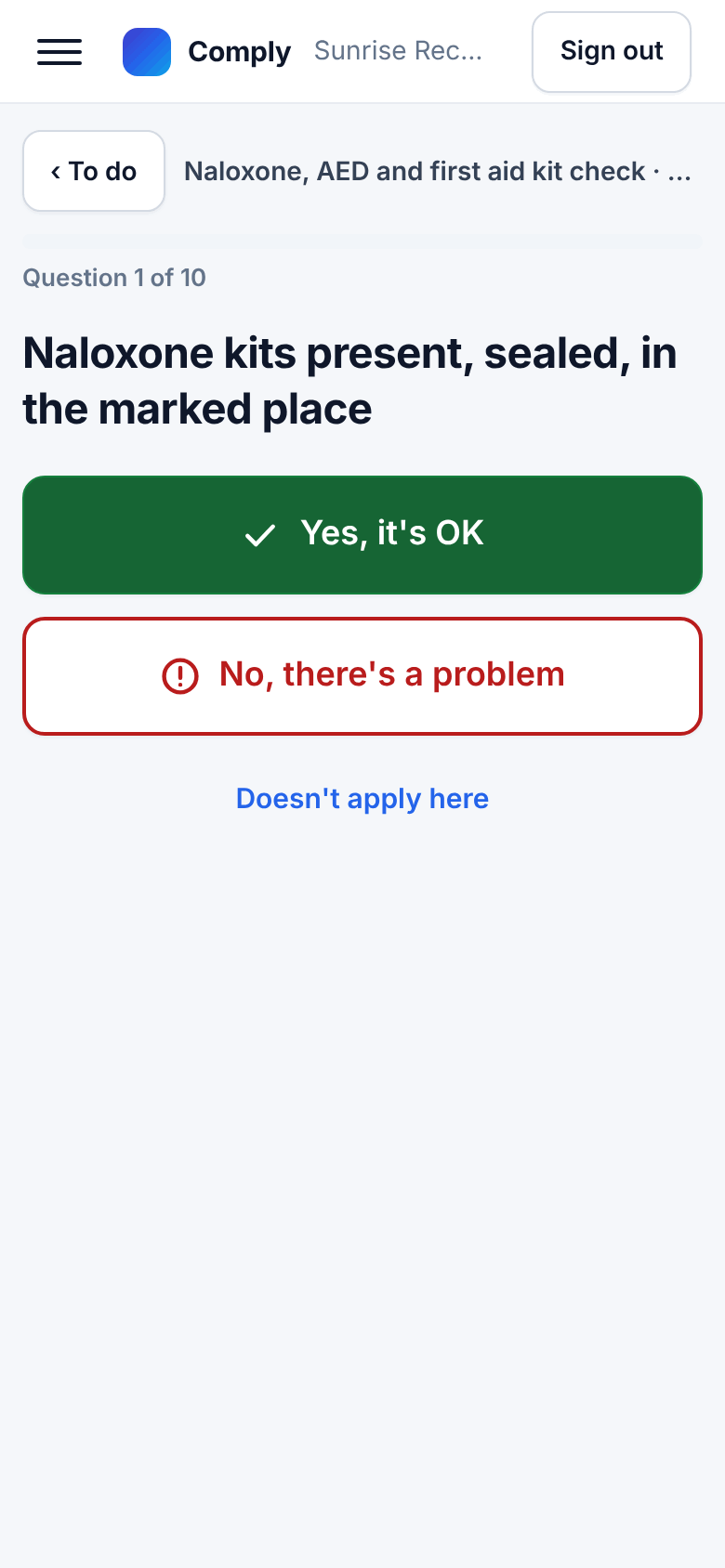
The weekly safety walk
Between full rounds, a short walk catches what changes week to week. Ours has 12 checks: exits clear and opening freely; exit signs lit; no daisy-chained or frayed cords; trash emptied with no piles near heat; no smoking inside or within the posted distance; doors and locks working, records and medication rooms locked; bathrooms clean and stocked; client areas cleaned this week; furniture sound; first aid kit in place; naloxone in place and visible; no trip hazards or wet floors. It maps to the same standards as rounds (EC.02.01.01, EC.02.03.01, EC.02.06.01) and goes in the same binder.
Turning findings into fixes
A rounds sheet full of "fail" and nothing after it is a finding of its own. For each failed line:
- Fix it on the spot if you can (move the box out of the corridor, empty the trash) and note "fixed during rounds," with a photo.
- Otherwise open a corrective action: what's wrong, where, who fixes it and by when. We give life-safety problems (exits, alarms, extinguishers, emergency lights) 2 business days and everything else a week or two.
- Close it with proof: a note of what was done and an after photo. A work order to the landlord counts as action, not as a fix; keep it open until the work is done.
- Watch for repeats. The same finding three months running means the fix didn't work. Change the process, not just the item.
Building systems you don't control still count. If the landlord maintains the fire alarm, sprinklers and HVAC, get copies of each vendor's yearly report for your binder: extinguisher service, fire alarm test, sprinkler inspection and the 90-minute emergency light test.
Reporting to the quality committee
Each quarter, the committee that oversees quality and safety reviews the environment of care (EC.04.01.01, PI.02.01.01): rounds results and open fixes, drills and their critiques, safety incidents and injuries, equipment, utilities and recalls. The minutes are the proof, so they should say what was reviewed and what was decided, and be signed and filed.
Once a year, leadership evaluates each environment of care plan in writing (scope, objectives, performance and effectiveness): the Safety, Security, Fire Safety, Hazardous Materials and Waste, Medical Equipment and Utility Systems plans, with goals for next year. Rounds data is most of what goes into that evaluation. The same yearly cycle includes the hazard vulnerability analysis and the emergency operations plan review.
How Comply runs rounds
Comply builds rounds from your setup answers, so the AED, eyewash, medication and drug-screen lines only appear if you have them, and each building gets its own monthly rounds and weekly walk. On the day:
- One item at a time on a phone, pass, fail or N/A, with a photo on any line (exits get a photo slot by default).
- Every failed line opens a fix with an owner and a due date, and the overview shows open fixes until they're closed with a note.
- Signed with the person's name and the server's time. Work done earlier and logged later is marked late with both dates; nothing is backdated or deleted.
- The quarterly report to the committee is its own task, and Comply's quarterly quality report lists the period's rounds, drills and fixes for the committee to review.
- The survey binder lists every round by building and month with the photos, by chapter.
See it on a made-up program in the Comply tour, or read the full list of recurring work in the compliance calendar.
Rounds that happen, and fixes that close
Comply puts the walk on the right person's list each month, walks them through it on their phone, and keeps every photo and fix ready for a surveyor.
Questions
How often should environment of care rounds be done in behavioral health?
As often as your Safety Management Plan says, and every building counts separately. Monthly full rounds with a short weekly safety walk is a common pattern for outpatient programs; residential and locked settings often walk more often. Whatever you choose, write it once, make every plan agree, and keep it.
What's the difference between EOC rounds and a safety walk?
A safety walk is a short check of what changes week to week (exits, cords, trash, locks, supplies). EOC rounds are the full inspection across fire safety, security, hazardous materials, infection control and equipment, with findings reported to the quality committee.
Do outpatient programs need EOC rounds?
If you're accredited, yes: the Joint Commission's EC chapter and CARF's health and safety standards apply to outpatient programs, and surveyors walk the building. If you're not, rounds are still the cheapest way to find the blocked exit or expired extinguisher before a fire marshal or state surveyor does.
Who should do the rounds?
One named owner, usually operations or facilities, with a clinician or the program director joining at least quarterly. Clinicians notice self-harm risks and privacy lapses that operations staff can miss.
What do surveyors want to see?
Dated rounds for every building and month, photos of findings, a corrective action for each failure with the date it closed, and committee minutes showing the results were reviewed.
More in this set: the Texas HHSC inspection checklist, the hazard vulnerability analysis, the emergency operations plan, the ligature risk assessment and incident reporting timelines. Drills have their own guide: fire drill requirements. Want a person to walk your building first? Cima Consulting's mock survey ($3,500) includes an environment tracer.
Sources
- OSHA: 29 CFR 1910.36 and 1910.37 (exit routes), 1910.157 (portable extinguishers: monthly visual inspection, yearly maintenance), 1910.303 (working space around electrical equipment), 1910.1200 (hazard communication and Safety Data Sheets), 1910.1030 (bloodborne pathogens, sharps containers).
- NFPA, NFPA 101, Life Safety Code (7.9.3, emergency lighting tests) and NFPA 13 (sprinkler clearance). Both are copyrighted; your jurisdiction adopts a specific edition.
- The Joint Commission, 2025 Survey Activity Guide, Behavioral Health Care and Human Services. Standard numbers are cited only; check your current manual.
- CARF, Our standards (health and safety, section 1.H).
- 26 Tex. Admin. Code 564.508 (records) and 564.1207 (residential heating).
This guide is general information, not fire-code or legal advice. Comply isn't affiliated with or endorsed by The Joint Commission, CARF, NFPA or OSHA.
Walk the building before the surveyor does.
A 20-minute Comply walkthrough sets up rounds, drills and checks for your program and every building.
Book a walkthrough