A free guide from Comply
Preparing for a CARF survey in behavioral health
What's different about a CARF survey, the recurring compliance work it shares with the Joint Commission and state licensing, and a month-by-month plan from a year out to the report.
Updated October 24, 2026. CARF's standards manual is sold by CARF and changes each year; buy the edition for the year you'll be surveyed and check every detail against it.
How CARF differs from the Joint Commission
Both accredit behavioral health programs, and both expect safe buildings, good records, qualified staff and a working quality program. The way they get there differs:
| What | CARF | The Joint Commission |
|---|---|---|
| Scheduling | You apply for a survey; CARF suggests sending the application at least three months before the timeframe you want. | Most behavioral health surveys are unannounced or on short notice. |
| The surveyors | Peer surveyors, who interview consenting current and former persons served and, where it applies, their families. | Surveyors trace individuals served through the program, starting from their records and the staff who served them. |
| How the standards are built | Section 1, ASPIRE to Excellence (business practices and quality improvement), and Section 2, General Program Standards, apply to every program; then the core program standards for what you offer, and any population standards. | Chapters by topic: Environment of Care, Emergency Management, Record of Care and the rest. |
| The result | Three-Year, One-Year, Provisional or Nonaccreditation, based on conformance to the standards. | An accreditation decision; your manual's Accreditation Process chapter explains what follows a finding. |
| Between surveys | A Quality Improvement Plan within 90 days of the decision, then an Annual Conformance to Quality Report each year. | A yearly self-assessment against the standards (the Focused Standards Assessment). |
Section numbers in CARF's manual have moved between editions, so this guide names sections only where we could check them. Comply isn't affiliated with or endorsed by CARF or The Joint Commission.
The recurring work that overlaps
Most of a program's recurring compliance work answers to every reviewer at once: the accreditor, the state licensing surveyor and your own policy manual. If you're switching from the Joint Commission to CARF, or adding CARF to a state license, keep doing this work; only the way it's cited changes. By topic:
- Health and safety (CARF Section 1.H): safety walks and inspections, fire extinguishers and emergency lights, first aid, naloxone and AED checks, infection control, and the vendor reports for the fire systems.
- Emergency procedures: CARF asks for unannounced tests of each emergency procedure, with a written analysis (1.H.7). Rotate fire, severe weather, an active threat, a medical emergency, a bomb threat and a utility failure across shifts. See fire drill requirements.
- Records: CARF's behavioral health standards have called for a quarterly review of a representative sample of current and closed records (2.H). See the chart audit checklist.
- Rights and grievances: rights posted and explained, a grievance log, and every grievance answered in writing on time.
- Staff: licenses verified at the source, background checks, orientation, yearly training, and CPR and de-escalation cards.
- Quality and outcomes: incidents reviewed for trends, client satisfaction and outcome measures, and leadership's annual review of the program.
- Privacy and technology: the HIPAA security risk analysis, Part 2 consents, backups tested, and a plan for a breach.
- Policies and plans: the policy manual reviewed and approved each year, and the emergency plan reviewed after drills and real events.
The full list, with how often each happens, is in the compliance calendar, and the same work organized by Joint Commission chapter is in the Joint Commission checklist.
A prep timeline
CARF's own preparation guide sets the 12-, 9- and 3-month marks below. The rest is what we'd do.
- 12 months out Buy the current standards manual for your programs. Form a small preparation committee and name one person as the contact who coordinates it. Read the standards that apply: Sections 1 and 2, plus the core program and population standards for what you offer.
- 11 months Start the recurring work now, so there's a year of records by the survey: safety checks, drills, chart reviews, training. Surveyors want to see that it happens every time, not that it was written up at the end.
- 9 months Do a presurvey with CARF's survey preparation workbook. Every nonconformance becomes a fix with an owner and a date.
- 6 months Rewrite the policies that don't match what you actually do, train staff on the changes, and hold the first full quarter of quality committee reviews with real data.
- 3 months or more Submit the survey application in CARF's Customer Connect, at least three months before your preferred survey timeframe.
- 1 to 2 months Run a mock survey: walk the building, read a sample of charts, interview a few staff and ask them what they'd do in a fire or an overdose. Organize your evidence so a surveyor can find each item fast.
- Survey Have your contact, your evidence and your leadership available. Tell staff and persons served that surveyors may ask to talk with them.
- After Read the report, then send CARF your Quality Improvement Plan within 90 days of the decision.
What surveyors look for
CARF's accreditation reports describe surveyors determining conformance from what they observe, the documents they review, and interviews with staff and persons served. In practice that means three things have to agree:
- What your policy says (for example, "unannounced tests of each emergency procedure on each shift").
- What your records show (the tests, on each shift, each with its written analysis and the changes made).
- What people tell the surveyor (a staff member on the evening shift remembers the last drill and knows the meeting place).
The most common gap is the middle one: work that's done but not written down, or written down once and then skipped. A year of on-time records closes it.
After the survey
- The decision. A Three-Year accreditation goes to programs that meet CARF's accreditation conditions and substantially conform to the standards; a One-Year means significant deficiencies the organization is shown able and committed to correct.
- The Quality Improvement Plan. Within 90 days of the decision, tell CARF what you've done or will do about each recommendation in the report.
- Every year after. Submit the Annual Conformance to Quality Report, and keep the recurring work going. The next survey looks at whether you kept improving.
Where Comply fits
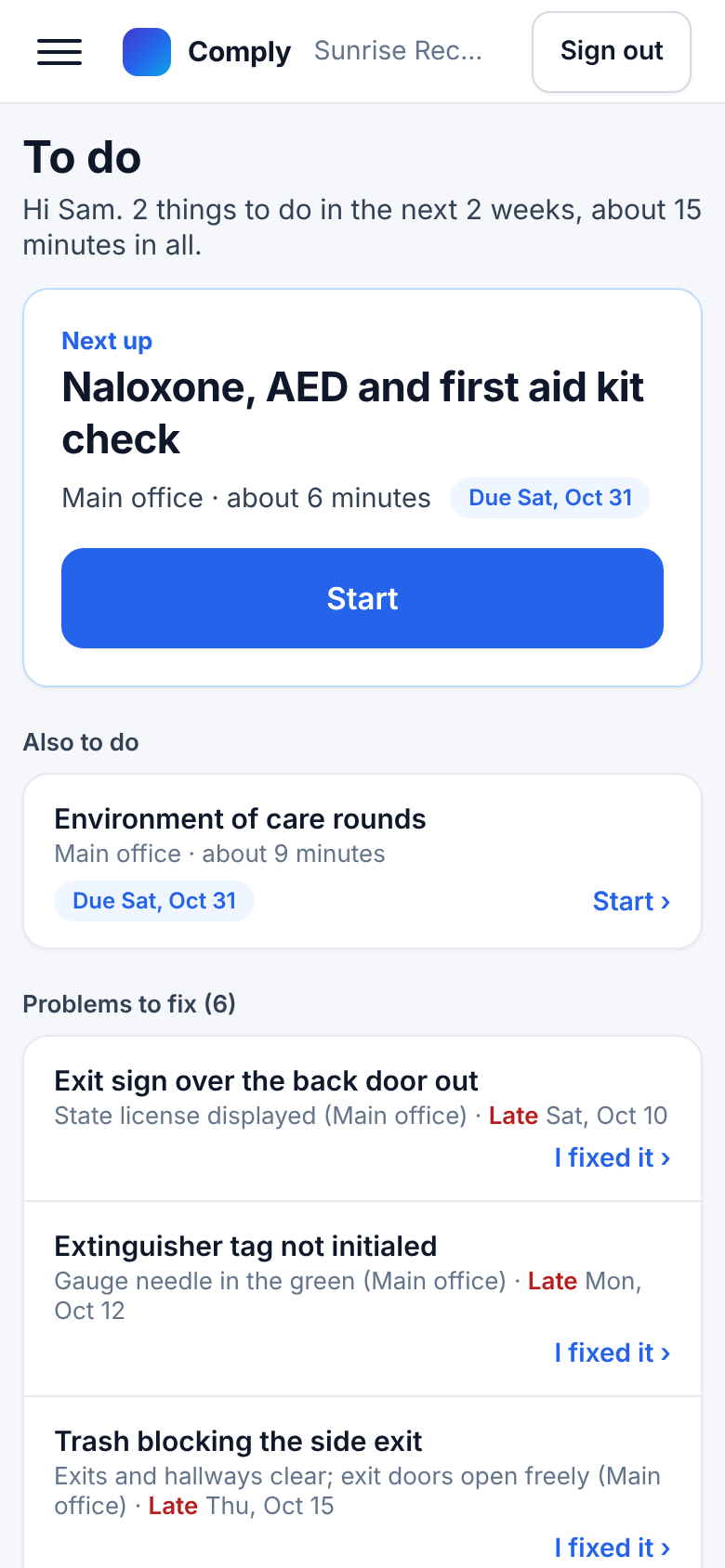
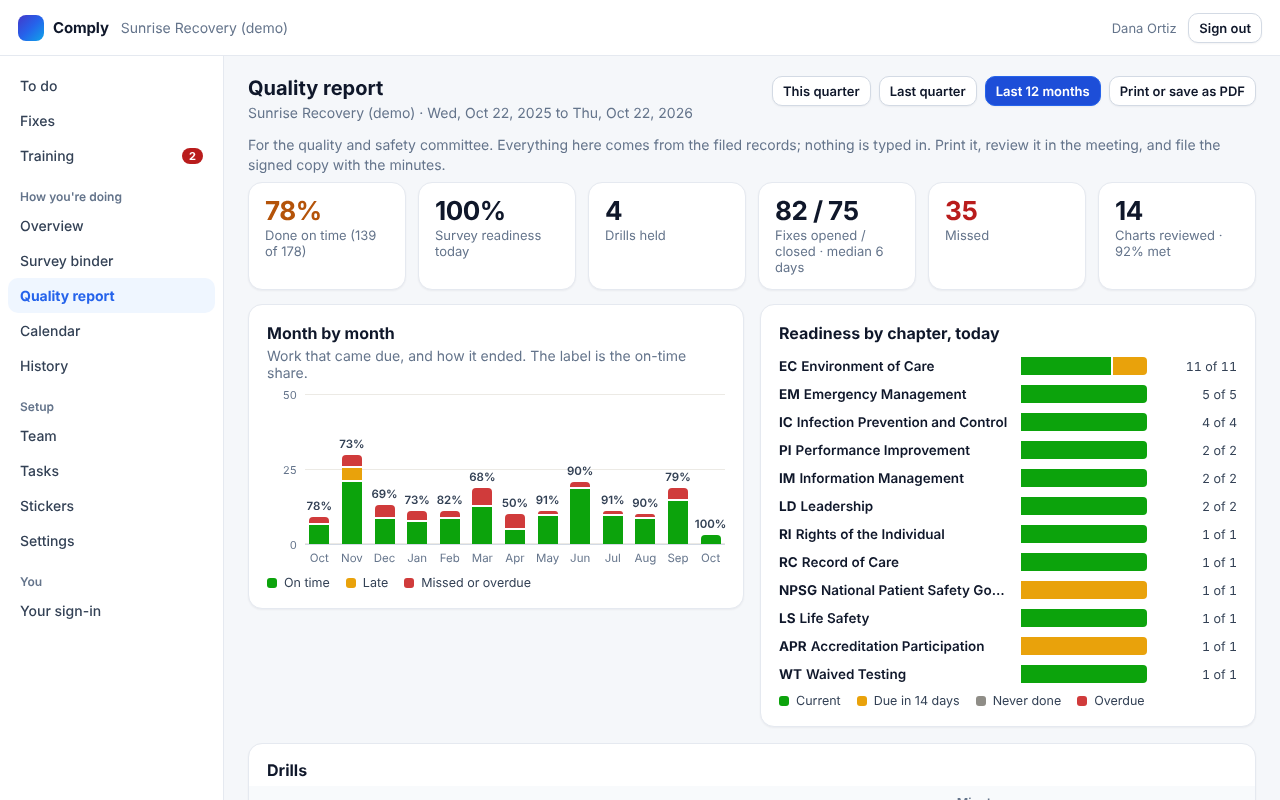
Comply runs the recurring part: during setup you choose CARF as your accreditor (the Joint Commission's yearly self-assessment then drops off), and it schedules the safety checks, drills, chart reviews, training and yearly plans with owners and due dates. Each person does their work on a phone; failed items become fixes; everything lands in one binder you can print.
Comply's tasks cite Joint Commission standard numbers. For CARF, the work is the same; map each task to your manual's section in your own crosswalk.
Start your year of records now
Comply sets up your recurring tasks from your accreditor, state and building in a few minutes, and keeps everyone on schedule until survey day.
Want help with the whole process? Cima Consulting offers accreditation readiness ($9,500) and one-day mock surveys ($3,500), or a program launch carried through accreditation.
Questions
Are CARF surveys unannounced?
Generally no. You submit a survey application and CARF schedules the survey; CARF suggests applying at least three months before the timeframe you want. Check CARF's current accreditation policies for notice rules.
Do CARF surveyors talk to clients?
Yes. CARF's reports describe confidential interviews with consenting current and former persons served, and with family members or other supporters where that applies.
How long does CARF accreditation last?
A Three-Year accreditation is the highest outcome. A One-Year accreditation is given when there are significant deficiencies the organization can correct. Either way, CARF expects an Annual Conformance to Quality Report each year.
Does Comply cover the CARF standards?
Comply covers the recurring work that CARF, the Joint Commission and state licensing share: drills, safety checks, chart reviews, training and yearly plans. It cites Joint Commission numbers; use your CARF manual to map each task. Comply isn't affiliated with or endorsed by CARF.
Related guides: the Joint Commission survey checklist, fire drill requirements, the chart audit checklist and the compliance calendar. Or see how Comply works.
Sources
- CARF, Preparing for an accreditation survey (12-, 9- and 3-month steps; the survey preparation workbook; Customer Connect).
- CARF, Steps to accreditation (Quality Improvement Plan within 90 days; Annual Conformance to Quality Report).
- CARF, Accreditation decisions (Three-Year, One-Year, Provisional, Nonaccreditation).
- CARF, Our standards (ASPIRE to Excellence in Section 1).
- Maryland Behavioral Health Administration, CARF reference grid (Sections 1 and 2 for every program; core and population sections).
- Example CARF accreditation report, Delaware PBHS, 2025 (peer surveyors; interviews with persons served).
- Ohio Department of Mental Health and Addiction Services, CARF behavioral health standards update (1.H.7 emergency procedure tests with written analysis; 2.H quarterly record review).
- The Joint Commission, 2025 Survey Activity Guide, Behavioral Health Care and Human Services.
This guide is general information, not legal advice or a substitute for CARF's manual and policies. Comply isn't affiliated with or endorsed by CARF or The Joint Commission.