A free guide from Comply
Client grievance procedure for Texas treatment programs (26 TAC 564.702)
What the Texas rule for licensed chemical dependency treatment facilities requires of a client grievance procedure, subsection by subsection; the two clocks (24 hours and 7 days); the central grievance file; the federal privacy complaint rules that sit beside it; an outline you can adapt; a log template; and what an HHSC surveyor and an accreditor will check.
Updated October 27, 2026. Rule text is from 26 TAC chapter 564 as published after HHSC moved it from 25 TAC chapter 448 in April 2024; confirm the current text before you adopt a policy.
The short answer: a licensed Texas chemical dependency treatment facility gives each client and consenter a copy of the grievance procedure within 24 hours of admission and explains it in plain words (26 TAC 564.702(b)). The procedure must tell clients they can grieve any violation of their rights or of program rules, put it in writing and get help doing so, ask for writing materials, postage and phone access, and complain directly to HHSC at any time, with the current mailing address and toll-free number (564.702(c)–(d)). The program answers each grievance in writing within 7 days and keeps every grievance and its final disposition in a central file (564.702(e)). The procedure is also posted, in English and a second language (564.506).
Where the rule sits
Client grievances are 26 TAC §564.702, in Subchapter G (Client Rights) of chapter 564, "Chemical Dependency Treatment Facilities." HHSC moved the chapter from 25 TAC chapter 448 to 26 TAC chapter 564 effective April 30, 2024 (Texas Register transfer notice), and the section numbers carried over, so older policies that cite "25 TAC §448.702" mean the same rule. Many sections still say "the Commission" or "TCADA"; read both as HHSC.
Four other sections work with it:
| Rule | What it adds to the grievance process |
|---|---|
| 564.701 Client Bill of Rights | The rights a grievance can be about, including the right to complain and get a fair response, and to complain directly to HHSC. Clients get a copy before admission, with HHSC's address and phone number, and an explanation in simple terms within 24 hours. |
| 564.506 Postings | The Bill of Rights, HHSC's complaint poster and the grievance procedure are posted in English and a second language. |
| 564.802 Consent | The consent to treatment covers the grievance procedure among its elements, and information goes to the consenter in their primary language when possible (564.802(e)). |
| 564.703 Abuse, neglect and exploitation | An allegation of abuse, neglect or exploitation isn't held for the grievance process: it goes to HHSC immediately (see incident reporting timelines). |
What 564.702 requires, subsection by subsection
| Subsection | Requirement | Proof a surveyor can see |
|---|---|---|
| (b) | Staff give each client and consenter a copy of the grievance procedure within 24 hours of admission, and explain it in clear, simple terms. | A signed, dated receipt in the chart, no later than 24 hours after admission, signed by the consenter too for a minor who doesn't consent for themselves. |
| (c)–(d) | The procedure tells clients they can grieve any violation of their rights or of program rules; submit the grievance in writing and get help writing it; ask for writing materials, postage and phone access; and complain directly to HHSC at any time, with the current mailing address and toll-free number of HHSC's investigations. | The procedure and the grievance form, current version, with every item and HHSC's contact details. |
| (e) | The program responds to the client in writing within 7 days of receiving a grievance, and keeps all grievances and their final disposition in a central file. | The central grievance file or log, with the date received and the date of the written response for each one; copies of the responses. |
The rule says 7 days, not 7 business days. Count calendar days in your policy so a weekend or holiday never makes a response late. Our sister site's 26 TAC 564 requirements guide lists the chapter's other deadlines in one table. Cima Consulting and Comply aren't law firms; read the official text of each rule.
The clocks, from admission to the quarterly review
| When | What happens | Rule |
|---|---|---|
| Before admission | The client gets the Bill of Rights, with HHSC's address and phone number. | 564.701(a) |
| Within 24 hours of admission | Rights explained in simple terms; the grievance procedure given to the client and consenter and explained; both acknowledged in writing. | 564.701(a), 564.702(b) |
| Always | The rights, HHSC's complaint information and the grievance procedure posted, in English and a second language. | 564.506 |
| The day a grievance comes in | Logged in the central file; anything about abuse, neglect, exploitation or immediate safety goes to the CEO and HHSC right away instead. | 564.702(e), 564.703 |
| Within 7 days of receiving it | A written response to the client. | 564.702(e) |
| When it's closed | The final disposition recorded in the central file. | 564.702(e) |
| Each quarter | Leadership reviews grievances with incidents and complaints for trends, and records what changed. | Your performance improvement plan (Joint Commission PI.02.01.01, RI.01.07.01, LD.03.09.01) |
What the written procedure should say
An outline built from 564.702 and the grievance policy in the kit we use at a licensed Texas outpatient program. Items marked rule come from the rule; the rest is our practice, and you can set your own (shorter is fine, longer than the rule isn't).
- Purpose and promise. Every client may complain without fear; we answer fairly and in writing; no one is treated differently for filing.
- Definitions. A complaint is a concern staff can fix on the spot (a schedule mix-up). A grievance is one that isn't resolved right away, that the client asks to handle formally, or that involves rights, safety, privacy or billing. Write down every complaint that isn't fixed the same day.
- What can be grieved (rule): any violation of the client's rights or of program rules.
- How to file (rule for writing, help, materials, postage and phone): tell any staff member, use the form at the front desk, write, call or use the portal. Staff help anyone who needs help writing it; interpreters at no cost. Anonymous grievances are accepted.
- Safety first (rule, 564.703): an allegation of abuse, neglect or exploitation, or an immediate safety concern, goes to the CEO and HHSC at once and is never held for the grievance process.
- Who handles it. Named by role (program director, clinical director); no one investigates a grievance about themselves.
- Acknowledgment. We acknowledge in writing within a few business days, naming who is handling it.
- The written response within 7 days (rule): what we found, what we'll do, and how to take it further.
- Appeal inside the program. To the owner or CEO, with a deadline for both sides.
- Outside options (rule for HHSC): HHSC at any time, with the current mailing address and toll-free number; HHSC's complaint and incident intake (1-800-458-9858 when we checked; verify before posting); the licensing board of any clinician involved, such as the Behavioral Health Executive Council for counselors, social workers, marriage and family therapists and psychologists, or HHSC's LCDC program; the HHS Office for Civil Rights for privacy; the client's health plan; and the accreditor's complaint office if you're accredited.
- No retaliation. Filing never changes a client's services, schedule, level of care or discharge; staff who retaliate are disciplined.
- Records and review (rule for the central file): what the log records, who keeps it, how long (we keep 6 years), and the quarterly review.
For a client who wants help outside the program, the Texas HHS Office of the Ombudsman also has a behavioral health help line.
The central grievance file: a log template
564.702(e) asks for all grievances and their final disposition in a central file, not only in the chart. One row per grievance; keep clinical detail out of it, since the log is read in leadership meetings and by surveyors.
| Column | What goes in it | Example (made up) |
|---|---|---|
| Number | Year and sequence | 2026-014 |
| Received | Date, how (in person, form, phone, portal) and by whom | Oct 6, form at front desk, received by intake coordinator |
| Client | Chart number, not name | #1132 |
| Category | Rights, program rules, staff conduct, privacy, billing, environment, other | Program rules |
| Summary | One or two lines in the client's terms | Says phone privileges were taken away without warning |
| Safety screen | Abuse, neglect, exploitation or safety? If yes, when reported and to whom | No |
| Handled by | Role and initials | Clinical director, K.M. |
| Written response | Date sent; days from receipt (must be 7 or fewer) | Oct 10 (4 days) |
| Finding and action | Substantiated or not; what changed | Substantiated: rule wasn't in the written program rules; rule added and reviewed with all groups |
| Appeal and outside complaint | Appealed? Went to HHSC or a board? | None |
| Final disposition | Date closed and outcome | Closed Oct 17, resolved |
Writing the 7-day response
The rule asks for a written response, not a phone call. A good one is short and specific:
- Thanks the client for raising it and restates the concern in a sentence.
- Says what you looked at (who you talked to, which records and rules).
- Says what you found, plainly, including when the client was right.
- Says what will change and by when, or why nothing will.
- Says how to appeal inside the program, and that they can contact HHSC at any time, with the address and toll-free number.
- Is dated, signed and copied to the central file.
"You told us on October 6 that your phone privileges were taken away without warning. We talked with you and the group facilitator and read the program rules you signed at admission. You were right: the phone rule wasn't in the written rules you received. We've added it, reviewed it with every group this week, and restored your privileges. If you're not satisfied, you can appeal to the program director by October 24, and you can contact the Texas Health and Human Services Commission at any time at [current mailing address] or [toll-free number]."
Privacy complaints: HIPAA and 42 CFR Part 2
A grievance about privacy is also a complaint under federal law, with its own duties that run beside the Texas rule:
- HIPAA requires a covered entity to have a process for people to complain about its privacy policies and practices, to document every complaint and its disposition, and not to intimidate or retaliate against anyone who complains (45 CFR 164.530). Your notice of privacy practices tells clients how to complain to you and to HHS; the HHS Office for Civil Rights complaint portal is where they'd file.
- 42 CFR Part 2, since the 2024 rule, lets patients of substance use programs complain to the program and to HHS, and bars retaliation for it. Our sister site's 42 CFR Part 2 guide covers the 2024 changes.
- A privacy grievance may also be a reportable incident and a possible breach. A release of information without consent needs an internal incident report within 24 hours (564.509) and a breach risk assessment; see the HIPAA checklist and the HIPAA security risk analysis guide.
Joint Commission and CARF
- The Joint Commission expects you to address and resolve complaints from individuals served and their families (RI.01.07.01), and to look at complaints and grievances in performance improvement. Surveyors read the log and ask clients and staff how a complaint is made.
- CARF surveyors look for rights posted and explained, a grievance log, and every grievance answered in writing on time (see CARF survey prep). Check your current manual for the exact standard and any analysis it asks for.
- Where your accreditor's expectation and the Texas rule differ, follow the stricter one, and write it into the policy so staff aren't choosing between them.
What surveyors check, and common misses
From the Texas HHSC inspection checklist: the postings in both languages with HHSC's current contact information, the 24-hour grievance acknowledgment in each chart, and a central grievance file with a written response to each grievance within 7 days. Staff may be asked where the grievance forms are; clients may be asked whether they got a copy of their rights. The misses we see most:
- An old template that still says "TCADA" or "the Commission," with no phone number or an outdated address.
- The consenter left out for an adolescent client whose parent or guardian consents.
- A verbal answer only, or a response on day 9.
- Grievances that live only in the chart or in someone's email, so there's no central file.
- The procedure doesn't mention writing materials, postage and phone access, or complaining to HHSC at any time.
- An administrative discharge soon after a grievance with no documented, rule-based reason. Even when it's unrelated, it looks like retaliation; document the reason and the steps taken.
Where Comply fits
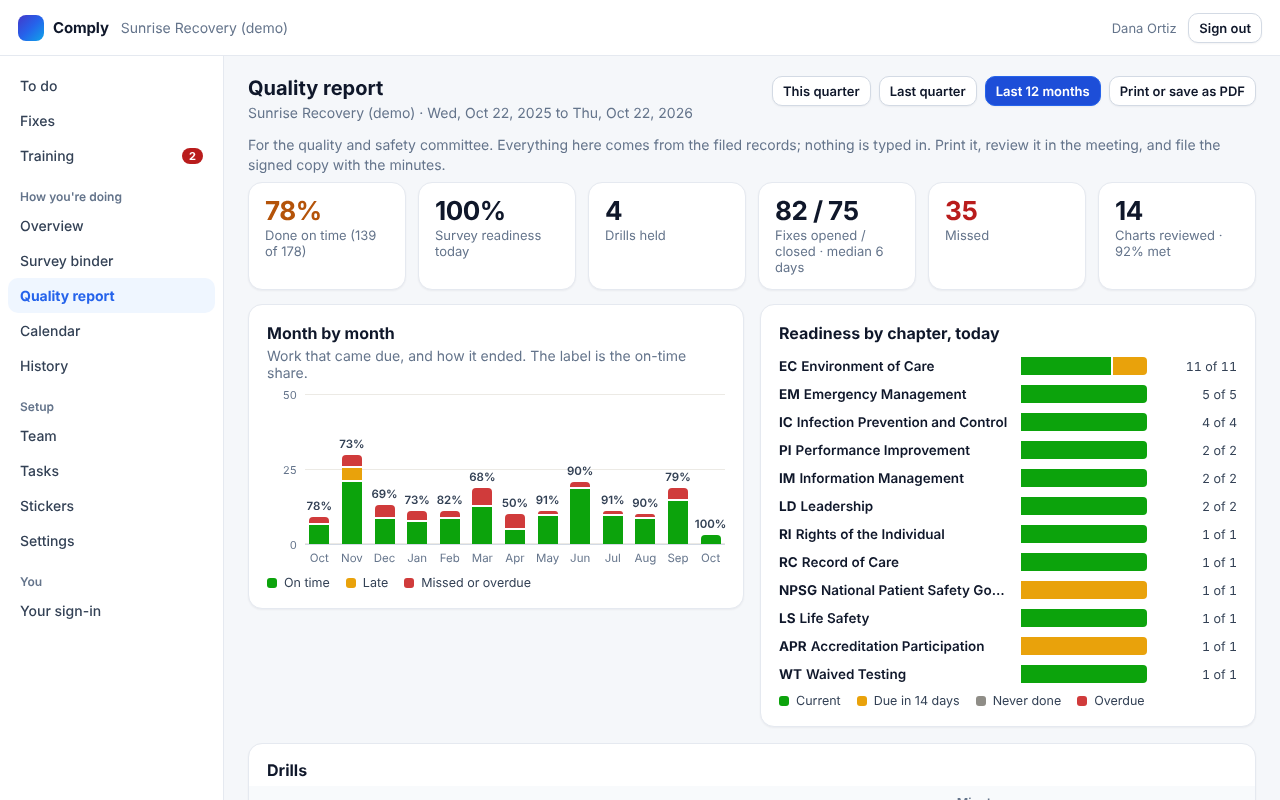
Comply holds no client information, so the log itself stays in your records. Comply makes sure the program side is done and provable: the monthly required postings check includes the grievance procedure with the state agency's phone number, with a photo; client rights and grievances training is a yearly requirement for every staff member; the quarterly chart review checks that rights, the grievance procedure and confidentiality were acknowledged; and the quarterly incident, grievance and complaint review records how many grievances came in and whether every one was answered in writing on time. A "no" becomes a fix with an owner and a date, and the record goes in the survey binder. See the full schedule in the compliance calendar.
Prove the grievance process works, every quarter
Comply schedules the postings check, the rights training and the quarterly review, and keeps the proof for HHSC and your accreditor. Book a 20-minute walkthrough.
Need the policy itself? Cima Consulting's program policy and procedure manual ($7,500) includes the grievance policy, the rights and grievance acknowledgments and the posters, checked against 26 TAC 564. Opening a new program? The CDTF license guide lists every form HHSC expects to see.
Questions
How long does a Texas treatment facility have to respond to a client grievance?
7 days from receiving it, in writing, under 26 TAC 564.702(e). Every grievance and its final disposition goes in a central file.
When does a client have to receive the grievance procedure?
Within 24 hours of admission. Staff give a copy to the client and the consenter and explain it in clear, simple terms (564.702(b)). Keep a signed, dated receipt in the chart.
Can a client complain to HHSC instead of using our grievance process?
Yes, at any time. The procedure itself must say so and give the current mailing address and toll-free number (564.702(c)–(d)), and the Bill of Rights includes the right to complain directly to HHSC (564.701).
Does a grievance about abuse go through the grievance process?
No. An allegation of abuse, neglect or exploitation is reported to HHSC and the CEO immediately under 564.703, with the CEO's written report within 2 business days. Log it, but don't hold it for the 7-day process.
Do grievances go in the client's chart?
The rule asks for a central file of all grievances and their final disposition. Keep the grievance and response there; the chart can note that a grievance was filed and answered if it matters clinically, without the full file.
Does the grievance procedure have to be in Spanish?
The posted grievance procedure, rights and HHSC complaint information must be in English and a second language your clients use (564.506), and information goes to the consenter in their primary language when possible (564.802(e)). In most Texas programs that second language is Spanish.
Where was this rule before 26 TAC 564?
25 TAC 448.702. HHSC transferred chapter 448 to 26 TAC chapter 564 effective April 30, 2024, and the section numbers carried over.
More in this set: the Texas HHSC inspection checklist, incident reporting timelines, the chart audit checklist and the Joint Commission checklist.
Sources
- 26 Tex. Admin. Code chapter 564, Subchapter G (Cornell LII): 564.702 (grievances), 564.701 (Client Bill of Rights), 564.703 (abuse, neglect and exploitation); also 564.506 (postings) and 564.802 (consent) in the full chapter.
- Texas Secretary of State, transfer of 25 TAC chapter 448 to 26 TAC chapter 564 (effective April 30, 2024).
- HHSC, File a complaint against a health facility; Chemical Dependency Treatment Facilities; Office of the Ombudsman, behavioral health help.
- 45 CFR 164.530 (complaints, documentation, no retaliation); HHS, filing a complaint with the Office for Civil Rights; 42 CFR Part 2.
- Texas Behavioral Health Executive Council; HHSC Licensed Chemical Dependency Counselor program.
The examples are made up. This guide is general information, not legal advice; the official text of each rule controls. Comply isn't affiliated with or endorsed by HHSC, HHS, The Joint Commission or CARF.
Every grievance answered, every quarter reviewed.
See how Comply keeps the postings, the rights training and the grievance review on schedule for your program.
Book a walkthrough