A free guide from Comply
The chart audit checklist for behavioral health records
How to run your own quarterly clinical record review: how many charts to pull, the 17 things to check in each one, how to score it, and how to turn what you find into fixes. Fill in the checklist right on this page, or print a blank copy.
Updated October 24, 2026. Written by the team behind a licensed Texas IOP/PHP program.
Why review your own charts
Surveyors read your records during tracers, and payer auditors read them to decide whether you keep the money. A program that reads its own charts first finds the missing signature, the late plan and the copy-and-paste note while they can still be fixed, and shows a surveyor it watches its own quality.
The Joint Commission's Record of Care chapter (RC.01.01.01, RC.02.01.01) covers what a record must contain, and its Performance Improvement chapter (PI.01.01.01) expects you to collect data on your own performance. CARF's behavioral health standards have called for a quarterly professional review of a representative sample of current and closed records (section 2.H in the editions we checked; confirm it in yours). Your state may set its own rules for what goes in a record and when; in Texas that's 26 TAC 564.
How many charts to pull
A common default, and Comply's: 20% of records each quarter, at least 5, drawn at random. Random matters: if the clinical director picks the charts, the review finds what she already knows. Use chart numbers only, never names, on the review.
- Small census? Below 25 charts, the minimum of 5 is more than 20%. Below 5, review them all.
- Include discharged charts if your accreditor expects closed records in the sample. The discharge summary is a frequent miss.
- Reviewer: a clinician, ideally not the counselor who wrote the chart.
The record-review checklist
Seventeen lines, grouped the way a chart is built. Mark each one Met, Not met or N/A (for example, no discharge yet). The score updates as you go. Nothing you enter leaves this page or is saved.
To print a blank copy, clear the form first. Print it once per chart in your sample, or fill it in here and print it with your marks.
Scoring a review
Score each chart, then the whole sample, the same way:
- Score = Met ÷ (Met + Not met). N/A lines don't count either way, so a chart with no discharge isn't penalized for a missing summary.
- The sample's score pools every line from every chart. Five charts × 17 lines is 85 lines; with 4 N/A and 6 not met, that's 75 met out of 81 scored, or 93%.
- Look at the lines, not just the number. If "plan reviewed when due" fails in three of five charts, that's one process problem, and the fix is a calendar or a training, not three reminders.
- Track it quarter to quarter. Set a target in your performance improvement plan and report the trend. A rising score is good evidence for a surveyor; a flat one with the same misses means the fixes aren't working.
Turning findings into fixes
A review without corrective actions is just a list. For each Not met line:
- Open a fix for that chart's counselor: the chart number, the line that failed, and what's missing.
- Give it a due date. Comply's default is 14 days for chart findings.
- Fix it honestly. A missing note or signature is added now, dated today, and marked as a late entry. Never backdate a note, and never change a signed one; correct it with an addendum that keeps the original.
- Close it with a note saying what was done.
- Report the results to staff and the quality committee: the score, the most common misses, and what will change.
- Check again next quarter. The next random sample shows whether the change worked.
A note on Part 2 consents
Substance use disorder records covered by 42 CFR Part 2 need the client's written consent for most disclosures. The 2024 Part 2 rule, with a compliance date of February 16, 2026, lets a program use a single consent for all future uses and disclosures for treatment, payment and health care operations, and it required updated notices. When you review the "release of information" line, check that each consent on file names who is disclosing and who is receiving, its purpose and expiration, and the notice about redisclosure, and that your forms were updated for the 2024 rule. Have your attorney confirm your forms; this guide isn't legal advice.
How Comply runs the review
Comply schedules the clinical record review every quarter and gives it to clinical staff only:
- It draws the sample. Paste the chart numbers of everyone in care (or, inside a host EHR, they come from the census) and Comply picks 20%, at least 5, at random. You can change both numbers.
- One checklist per chart, the same 17 lines as above, with notes on any line. Charts are recorded by chart number only, never names, and chart reviews aren't kept on the phone.
- Each Not met line becomes a fix, due in 14 days, with the chart number and the line. It goes to the clinician you chose for chart reviews, who can hand it to the chart's counselor.
- The score and the misses show up in the quality report for the committee, next to drills and safety checks.
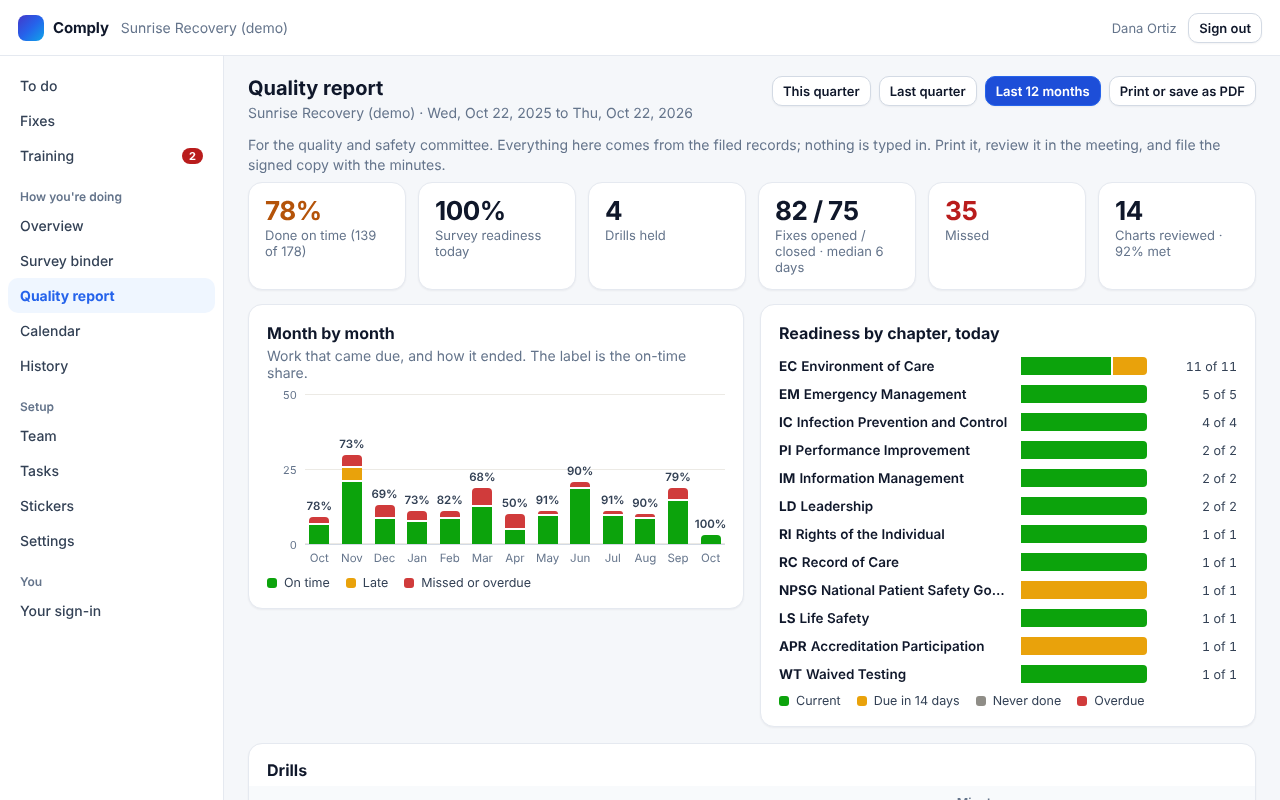
Let Comply run your quarterly chart review
The random sample, a checklist per chart, fixes assigned to the right counselor, and the score in the quality report. No client names, ever.
Prefer an outside reader? Cima Consulting audits charts the way a payer auditor or surveyor reads them: $750 per 10 charts, with a fix list for each. Related guides: the Joint Commission survey checklist, CARF survey prep, fire drill requirements and the compliance calendar.
Sources
- Ohio Department of Mental Health and Addiction Services, CARF behavioral health standards update (2.H quarterly review of a representative sample of current and closed records).
- Mintz, Ensuring compliance with the Part 2 final rule (March 2026: single TPO consent, consent contents, notices).
- Baker Donelson, HHS compliance deadline for updated Part 2 protections (February 16, 2026).
- 42 CFR §2.31 (consent requirements).
This guide is general information, not legal or billing advice. Comply isn't affiliated with or endorsed by The Joint Commission or CARF.