A free guide from Comply
Ligature risk assessment for outpatient behavioral health programs
What the Joint Commission actually expects of outpatient, IOP, PHP and residential programs (it isn't a ligature-resistant building), a room-by-room checklist for the environmental suicide risk assessment, a worked example of rating and mitigating what you find, and how to keep it current.
Updated October 24, 2026, against the Joint Commission's National Patient Safety Goals effective January 2026 for behavioral health care and human services.
The short answer: yes, non-inpatient programs need an environmental risk assessment. The Joint Commission says residential, partial hospitalization, day treatment, outpatient and intensive outpatient settings must do one under NPSG.15.01.01, EP 1, but they are not required to be ligature resistant. What's expected instead: find the features and objects in your space someone could use to harm themselves or others, identify the clients at high risk, protect them (remove or lock up items, supervise, monitor), and train staff on the risks you found. Do it room by room, at least yearly and after any renovation, and have leadership approve it.
What the Joint Commission requires
National Patient Safety Goal 15.01.01 is about reducing the risk of suicide. Its first element of performance asks for an environmental risk assessment. The Joint Commission's own behavioral health FAQ answers the outpatient question directly: environmental risk assessments are required for non-inpatient settings such as residential, partial hospitalization, day treatment, outpatient and intensive outpatient programs, and these settings are not required to be ligature resistant. Its reasoning: these levels of care are less restrictive than a locked unit, and clients can leave the building, so a ligature-resistant room wouldn't stop self-harm the way it can on an inpatient unit.
The expectation, from the FAQ and the Joint Commission's suicide prevention resources, is to:
- Assess the environment for things clients could use to harm themselves, visitors or staff.
- Identify the individuals at high risk for suicide, with a validated screening tool (EP 2).
- Take action to safeguard them, for example by removing items with a high potential for harm and keeping them in a secure place, or by monitoring.
- Educate staff about the risks you identified.
The goal's other elements cover assessment of clients who screen positive, documenting their level of risk and the plan to keep them safe, written policies for training and monitoring, counseling and follow-up at discharge, and checking that it all works. The 2026 behavioral health NPSG list still includes NPSG.15.01.01; the Joint Commission's move to National Performance Goals began with hospitals. The Joint Commission doesn't prescribe a format for the environmental assessment, so the checklist below is ours.
Comply isn't affiliated with or endorsed by The Joint Commission. Standards text is licensed, so this guide paraphrases and cites numbers. Read the current elements of performance in your own manual.
Ligature point, ligature resistant: the terms
- Ligature point: anything a cord, belt, sheet or other material can be looped around or tied to, and that would hold weight: hooks, exposed pipes, door hinges and closers, grab bars, shower heads, handles, the top of a door.
- Ligature resistant (the Joint Commission's definition, paraphrased): without points where a cord, rope, sheet or other material can be looped or tied to create a sustainable point of attachment. Inpatient psychiatric units are held to this; your outpatient office is not.
- Ligatures and other means: cords on blinds and electronics, belts, shoelaces, bags with straps, plastic bags; and beyond ligatures, sharps, medications, chemicals and anything heavy that could be thrown.
The room-by-room checklist
Walk every room clients use, during program hours. Note privacy (can a client be alone and unobserved there, and for how long?), what's attached to the walls and fixtures, and what's loose in the room. Photograph each risk.
1 Restrooms
The highest-risk room in most outpatient buildings: private, behind a locked door, full of fixtures.
- Fixtures: grab bars, toilet-paper and towel holders, coat hooks, exposed pipes under the sink, faucet handles, partitions.
- Door: hinges, closer arm, lever handle, and a lock staff can open from outside without delay.
- Loose items: trash can liners, cleaning supplies, anything left by the last person.
2 Group and counseling rooms
- Window coverings: blind cords and chains, curtain rods.
- Cords: phone chargers, lamp and TV cords, extension cords.
- Hooks and hardware: coat hooks, wall-mounted shelves, door closers.
- Furniture: pieces that can be stacked to reach a fixture, glass tabletops, breakable decor.
- Supplies: scissors, staplers, art supplies, the group facilitator's bag.
3 Offices, the front desk and staff areas
- Sharp and heavy objects on desks: letter openers, scissors, box cutters.
- Staff belongings: purses and bags (with medications) kept out of client reach.
- Medications and naloxone: naloxone accessible to staff, other medications locked.
4 Hallways, stairwells, windows and outside
- Stairwells: open stairwells and railings, especially ones out of staff view.
- Windows: ones that open wide on upper floors; balconies; roof access.
- Outside: the parking lot, smoking area and any unobserved corner of the property.
5 Storage, break room and the drug-screen area
- Chemicals and cleaning supplies locked, including the janitor's closet.
- Kitchen: knives, glass, the microwave cord.
- Drug-screen area: supplies, specimen cups, the restroom used for collection.
Some of these overlap with monthly environment of care rounds, which include a line for anything that could be used for self-harm. Rounds catch what changes month to month; the yearly assessment is the full, documented review.
Rating and mitigating what you find
Not every hook is a crisis. For each risk, ask two questions: how much privacy does the room give, and how easily could the feature or object be used? Then choose the cheapest effective fix. The options, from strongest to weakest:
- Remove it (take down the hook, bin the extension cord).
- Replace it with a lower-risk version where that's inexpensive (cordless blinds, a collapsible hook).
- Lock it away (sharps, chemicals, staff bags).
- Supervise or limit access (a restroom key at the front desk, time checks, keeping a room locked when it's not in use).
- Accept and manage with staff awareness, for features you can't change in a leased building, written down with the reason.
A made-up example, for an outpatient IOP in a leased office:
| Room | Risk found | Rating | What we do | Owner, by when |
|---|---|---|---|---|
| Client restroom | Coat hook on the back of the door; door locks from inside | High: private, weight-bearing | Remove the hook. Confirm staff can unlock the door from outside with the key kept at the front desk; add a time check after 10 minutes | Operations, 1 week |
| Group room B | Corded blinds; facilitator's bag on the floor | Medium: observed during groups, alone before and after | Replace with cordless blinds; bags stay in the staff office | Operations, 30 days; staff reminder now |
| Hallway | Exposed sprinkler pipe near the ceiling | Low: in view, out of reach | Accept and manage; landlord owns the system. Note in the assessment | Program director, at next review |
| Front desk | Scissors and a box cutter in an open cup | Medium: clients wait beside it | Move to a locked drawer | Front desk, today |
Whatever you decide, write down the risk, the decision and the reason. "We considered it and here's why we manage it this way" is what a surveyor wants to see; an unlisted hook in a private restroom is not.
Protecting clients at higher risk
In an outpatient program the person matters more than the building. The environmental assessment works together with:
- Screening with a validated tool at admission and when things change, and an assessment and safety plan for anyone who screens positive. Our chart audit checklist checks that the screen and the safety plan are in the record.
- A written procedure for a client at elevated risk during program hours: who stays with them, restroom access, how the room is cleared of items, and when to call 911 or arrange a higher level of care.
- Texas limits: licensed outpatient chemical dependency programs prohibit restraint and seclusion except as it relates to court-committed clients (26 TAC 564.706(b)), so the procedure relies on staying with the person, de-escalation and outside help. Direct-care staff need 4 hours of nonviolent crisis intervention training, then 2 hours a year (564.603).
- Crisis resources on closure messages and discharge paperwork, including the 988 Suicide and Crisis Lifeline.
If a client does harm themselves on site or attempts suicide, that's an incident with its own reporting clock; see incident reporting timelines.
Training staff
NPSG.15.01.01 expects staff to be educated on the risks your assessment found. Cover it at orientation and yearly:
- What a ligature point is, with photos from your own building.
- The specific risks you've decided to accept and manage, and what each staff member does about them.
- Keeping bags, sharps and medications out of client areas.
- The restroom procedure and the procedure for a client at elevated risk.
- Reporting a new risk the day they see it (new furniture, a contractor's tools, a broken fixture).
For a ready-made option, Cima Consulting offers a live staff training session ($500 per session) with a sign-in sheet for your training files.
How Comply schedules it
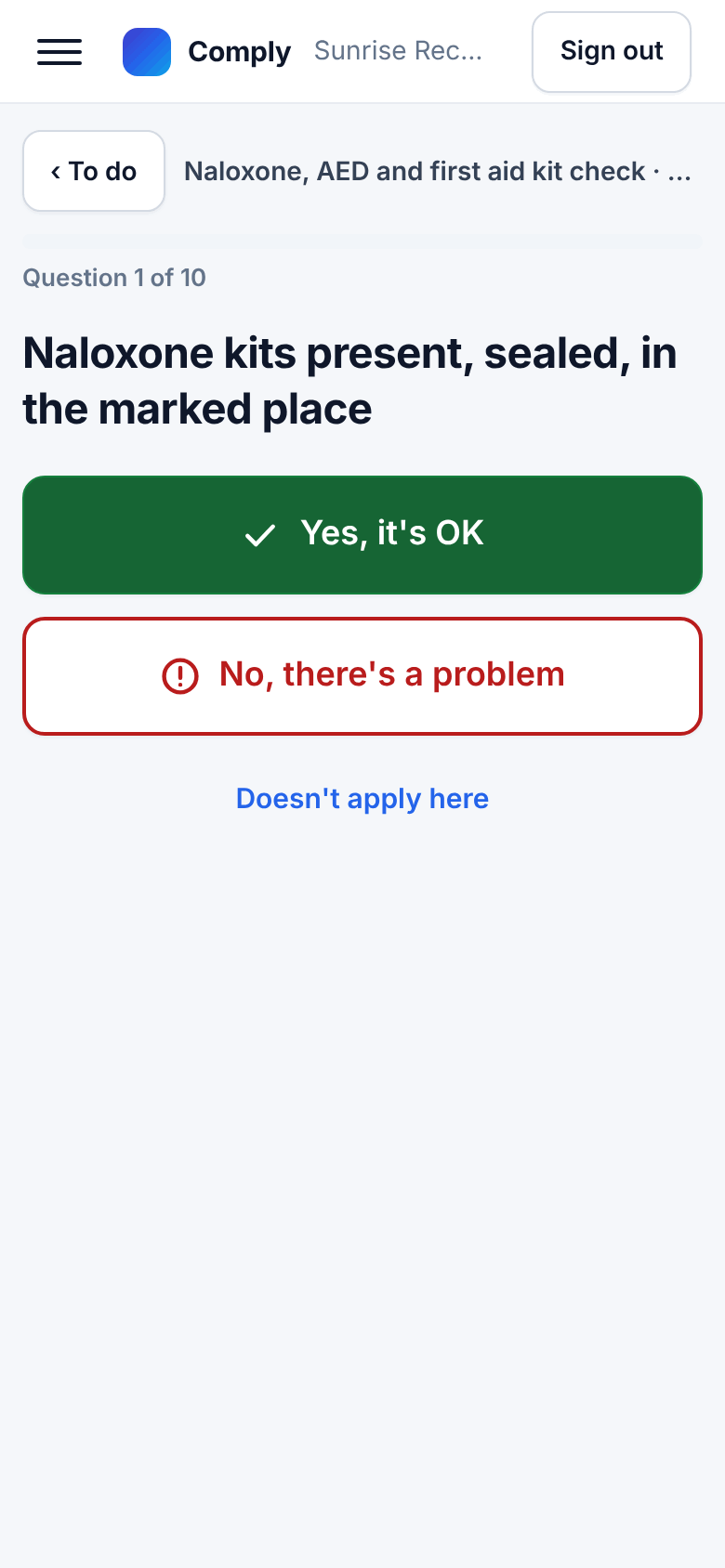
The environmental suicide risk (ligature) assessment is a yearly task in Comply, for each building, and one of the first scheduled for a new program. The checklist covers restrooms (grab bars, hooks, pipes, door hinges), group and counseling rooms (cords, blinds, hooks, furniture), doors (closers, hinges, over-door hangers), sharps, chemicals and cords locked away, windows and stairwells, and whether staff are trained to spot risks and watch higher-risk clients. A written list of the risks found and how each is handled is required, a photo can go on any line, and leadership approves it. Anything that fails becomes a fix with an owner and a due date, and the whole record is filed under National Patient Safety Goals in the survey binder. See the full yearly list in the compliance calendar.
Assess every room, every year, with the proof on file
Comply schedules the ligature assessment for each building, takes the photos, tracks each fix and keeps the record for your surveyor. Book a 20-minute walkthrough.
Questions
Do outpatient and IOP programs need a ligature risk assessment?
Yes, if accredited by the Joint Commission. Its FAQ says environmental risk assessments are required under NPSG.15.01.01 EP 1 for non-inpatient settings, including outpatient, intensive outpatient, partial hospitalization, day treatment and residential programs. Those settings don't have to be ligature resistant.
Does our outpatient office have to be ligature resistant?
No. The Joint Commission doesn't require non-inpatient behavioral health settings to be ligature resistant. It expects you to identify hazards, identify clients at high risk, and protect them, for example by removing items or monitoring.
How often should the environmental risk assessment be done?
At least once a year, and again after a renovation, a move, new furniture or fixtures, or a self-harm incident on site. Monthly environment of care rounds should flag new risks in between.
Is there a ligature risk assessment template?
The Joint Commission doesn't prescribe a format. The VA's Mental Health Environment of Care Checklist is a free, detailed item list built for inpatient mental health units; it's useful as a reference, but most of it is more than an outpatient office needs. The room-by-room checklist above is sized for outpatient programs.
Who should do the assessment?
A clinician and whoever runs the building, together, with leadership signing off. The clinician sees what a person in crisis could use; the operations lead knows what can be changed and what the landlord controls.
The rest of this set: environment of care rounds, the hazard vulnerability analysis, the emergency operations plan, incident reporting and the Texas HHSC inspection checklist. For the whole survey, see the Joint Commission checklist.
Sources
- The Joint Commission, FAQ: environmental risk assessments in non-inpatient behavioral health settings (NPSG.15.01.01 EP 1; not required to be ligature resistant) and FAQ: ligature-resistant products (definition).
- The Joint Commission, National Patient Safety Goals effective January 2026, Behavioral Health Care and Human Services; R3 Report on NPSG.15.01.01; Suicide prevention resources.
- U.S. Department of Veterans Affairs, National Center for Patient Safety, Mental Health Environment of Care Checklist.
- 26 Tex. Admin. Code chapter 564 (564.706(b), restraint and seclusion in outpatient programs; 564.603, staff training).
- 988 Suicide and Crisis Lifeline.
The example and its ratings are made up. This guide is general information, not clinical or legal advice. Comply isn't affiliated with or endorsed by The Joint Commission or the VA.
Look at every room the way a surveyor will.
See how Comply schedules the yearly assessment, rounds and fixes for each of your buildings.
Book a walkthrough