A free guide from Comply
Texas HHSC inspection checklist for chemical dependency treatment facilities
What a state surveyor checks when HHSC inspects a licensed Texas substance use program under 26 TAC 564, room by room and file by file, and the binder to have on the shelf before the knock on the door. Written by the team that runs a licensed Texas PHP, IOP and outpatient program.
Updated October 24, 2026. Rules as published in 26 TAC 564 and Texas Health and Safety Code chapter 464; confirm the current text with HHSC.
The short answer: HHSC can inspect a licensed chemical dependency treatment facility (CDTF) on a scheduled or unannounced basis, at any time services are provided, and you must give surveyors access to all records and let them interview clients and staff (26 TAC 564.407). Expect them to check five things: the license and postings, your policies, personnel files (credentials and training hours), client records against the 564 deadlines, and the incident, ANE and grievance files. Residential programs also get a physical plant review. Keep all of it in one binder at the site.
When HHSC inspects
The Texas Health and Human Services Commission licenses and regulates CDTFs under Health and Safety Code chapter 464. The rules are in 26 TAC chapter 564 (they moved there from 25 TAC chapter 448 on April 30, 2024, mostly without changing the text, so old forms that cite 448 mean the same section number in 564). A program usually meets a surveyor in four situations:
| Situation | What triggers it | What to expect |
|---|---|---|
| Initial licensing | Your Form 3207 application is materially complete | Under 564.403, HHSC inspects (when one is required) within 45 days of a materially complete packet and reports deficiencies within 30 days. With no clients yet, the review centers on the site, the policies and the staff. |
| Renewal | The license runs two years (HSC 464.004) | HHSC may inspect before renewing. Under HSC 464.005 and 464.0055 it accepts a current Joint Commission or CARF accreditation review in place of its own renewal inspection, if you submit the most recent review with the renewal application. |
| Complaint | A client, family member, staff member or anyone else calls HHSC Complaint and Incident Intake or files online | Usually unannounced and focused on the allegation, but surveyors can cite anything they see. Accreditation does not stop a complaint investigation (464.0055(c)). |
| Your own incident report | An abuse, neglect or exploitation allegation or other event you report to HHSC (see incident reporting timelines) | A follow-up that reads your incident file, your investigation and what you changed. |
Accreditation and the state license are separate. An accredited program can skip a renewal inspection, but it is still held to every line of 26 TAC 564, and the state's deadlines are often tighter than the accreditor's.
What happens on inspection day
The rule gives surveyors the right to inspect "at reasonable times," including whenever treatment services are provided, to see all records, and to interview clients and staff (564.407). In practice, plan for the visit to touch every part of the program:
- Arrival. Whoever is at the front desk should know to greet the surveyor, check identification, call the program director (or the designee named in your policy) and never ask them to come back later. Write the name of that designee into your front-desk quick guide.
- The entrance conversation. Expect requests for your current client list with admission dates and levels of care, a staff roster with credentials, the schedule of groups, and your policy manual.
- Records. Surveyors pull client records and read them against the 564 deadlines. Have a quiet room and a login (or the paper charts) ready, and someone who can find any document fast. Records must be retrievable on request at all times (564.508).
- Personnel files. Licenses, QCC status, background checks and training hours for the people whose names appear in the charts.
- The building. A walk through client areas: postings, locked records, exits, the medication room if you have one.
- Interviews. Staff may be asked what they would do if a client discloses abuse, or where the grievance forms are. Clients may be asked whether they got a copy of their rights.
- The exit. Ask what the surveyor found before they leave and write it down. The written findings come later.
The checklist, area by area
Each line is something a surveyor can check in minutes, the rule behind it, and the proof. For the full chapter in plain English, with every client-record deadline, see our sister site's 26 TAC 564 requirements guide.
1 License and postings
- License certificate displayed at each location and the services you provide match what's licensed.564.403; changes in status 564.405
- Client Bill of Rights, the HHSC complaint poster and the grievance procedure posted in English and in a second language your clients use.564.506
- The rights posting gives HHSC's current contact information. Old templates still say "TCADA" or "the Commission" without a phone number; replace them.564.701
- Abuse, neglect and exploitation reporting number posted where staff can see it.Your ANE policy (reporting duties in 564.703)
2 Governance and policies
- Operational plan and policy manual adopted by the governing body, with this year's review date.564.502
- Policies match what staff actually do. If one policy says "assessment within 72 hours" and the rule says 3 individual service days, the surveyor will ask which one staff follow.564.502, 564.803
- Written procedures for medical and psychiatric emergencies, and staff trained on them.564.707
- Utilization review that checks placement, adequacy of services and length of stay.564.504
- Outpatient programs prohibit restraint and seclusion (except as it relates to court-committed clients), and the policy says so.564.706(b)
3 Personnel files
- Every QCC qualifies: an LCDC, or a Texas LPC, LMSW, LMFT, psychologist, physician, PA, CARN or psychiatric APRN with at least 1,000 documented hours treating substance use disorders.564.1
- The clinical program director is a QCC with 2 or more years of post-licensure chemical dependency treatment experience.564.901(o)
- Counselor interns are registered and supervised by a QCC, who co-signs their plans and assessments.564.901
- Training hours for outpatient direct-care staff: 2 hours on abuse, neglect and exploitation; 3 hours on HIV, hepatitis, TB and STDs plus annual updates; 4 hours of nonviolent crisis intervention, then 2 hours a year. Initial training within 90 days and before doing the task.564.603(d)
- Staff who screen or authorize admissions have 8 hours of training (2 on DSM criteria) before they start, then 8 hours a year. Surveyors cross-check the screener names in charts against these records.564.603(d)(6)
- Background checks, job descriptions and license verifications dated and filed for everyone in the charts.564.601
4 Client records
- Screening dated and signed by the supervising QCC, with DSM criteria and a review of finances and insurance.564.801
- Admission authorized in writing by a QCC, naming the level of care, on or before the first service, with written justification for the outpatient setting.564.802(a), 564.904(c)
- Consent, rights and grievance procedure: consent before treatment; rights explained and the grievance procedure given within 24 hours of admission.564.802, 564.701, 564.702(b)
- Assessment signed by a QCC within 3 individual service days; treatment plan within 5; every service note within 72 hours.564.803(f), 564.804(f), 564.804(l)
- Discharge summary signed by a QCC within 30 days; follow-up contact 60 to 90 days after discharge.564.805(i)–(j)
- Nothing falsified, altered or backdated. Late entries are dated as late. Cloned notes and notes signed before the session ended draw citations.564.20(4), 564.507
- Records locked, need-to-know access, originals kept in Texas, electronic records backed up, kept at least 6 years.564.508
Practice the read before HHSC does it: our chart audit checklist scores a sample the same way.
5 Incidents, ANE and grievances
- A separate incident file (not the chart) with an internal report for each incident within 24 hours, signed with date and time.564.509(c)–(e)
- Every ANE allegation reported to HHSC right away, with the written reports and the investigation kept in a segregated file.564.703
- A chart note that describes an incident has a matching incident report. Surveyors read both.564.509
- A central grievance file with a written response to each grievance within 7 days.564.702(e)
6 Medications (if you handle them)
- Each dose documented, prescription and over-the-counter, with allergies, dose, route, time and the staff signature.564.1004
- Schedule II–IV counted daily; disposal within 30 days, witnessed by two staff.564.1003
7 The building
The physical plant subchapter of 26 TAC 564 (subchapter L) applies only to residential programs (564.1201). An outpatient office is governed by your city's building and fire codes instead, so the proof is local:
- Outpatient: the certificate of occupancy and the fire marshal's inspection for this address; exits clear and unlocked from inside; client records locked.Local code; 564.508
- Residential: evacuation procedures that cover people with disabilities, fire drills on each shift at least quarterly, and posted exit diagrams.564.1203
- Residential: a fire alarm system installed by a registered installer, tested by staff quarterly and documented, audible throughout.564.1206
- Residential: no portable electric heaters or open-flame heating; fuel-burning devices vented.564.1207
Even where the state rule is silent, a surveyor who sees a blocked exit or an expired extinguisher writes it down. The environment of care rounds checklist catches those first, and fire drill requirements covers drill frequency by occupancy.
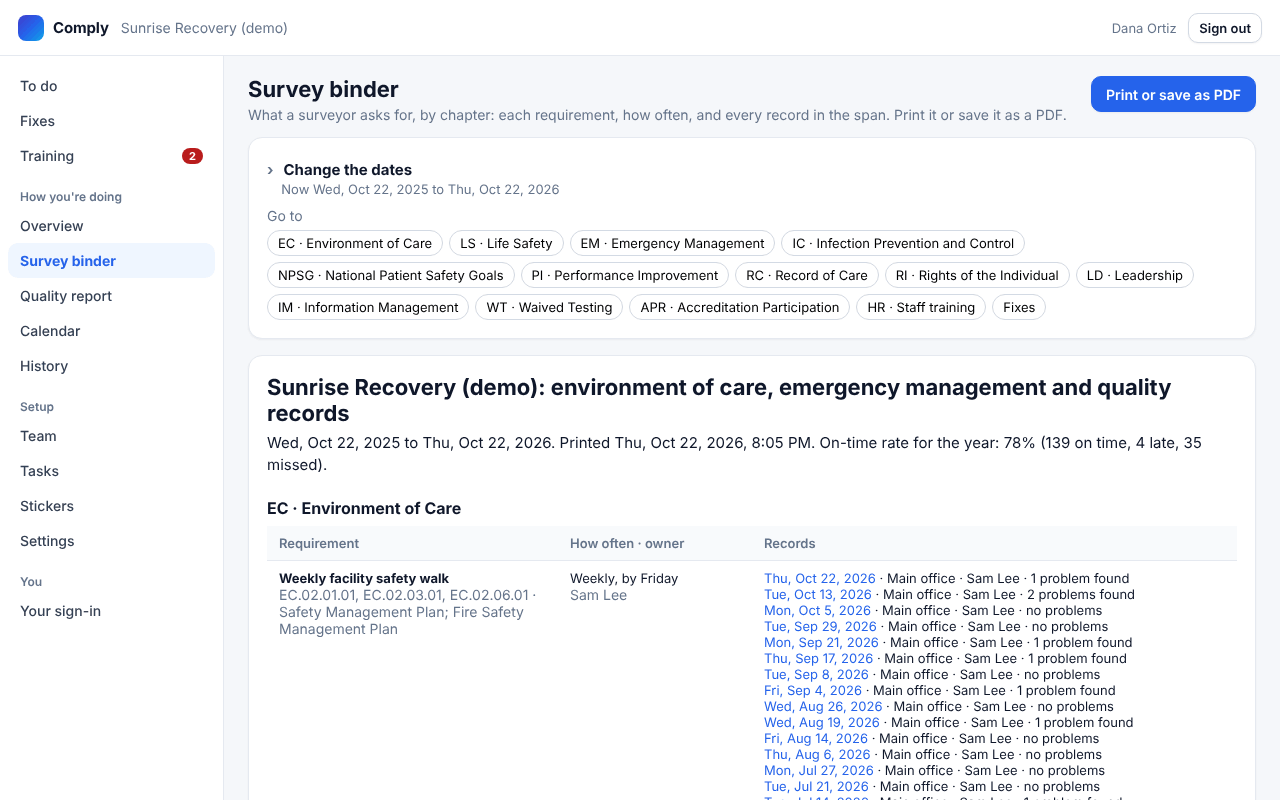
The inspection binder
Surveys can be unannounced, so the binder lives at the site, not in someone's inbox. Ours has these tabs, in this order:
| Tab | What goes in it |
|---|---|
| 1. License | Current HHSC license, renewal date, any change-in-status approvals, accreditation certificate and latest review |
| 2. Building | Lease, certificate of occupancy, fire marshal inspection, vendor reports for extinguishers, alarm and sprinklers |
| 3. Governance | Governing body roster and minutes, operational plan, organizational chart |
| 4. Policies | The manual with this year's review and approval, and a crosswalk from each 564 rule to the policy that meets it |
| 5. Staff | Roster with credentials and QCC status, training matrix with hours and dates, supervision logs for interns |
| 6. Safety | Emergency procedures, emergency operations plan, drill records, safety checks, the environmental risk assessment |
| 7. Quality | Chart review results, utilization review, the quarterly incident and grievance review |
| 8. Logs (kept apart from charts) | Where to find the incident file, the ANE file and the grievance file; who holds the key |
After the inspection: deficiencies and enforcement
- Read the written findings the day they arrive. Answer by the date in HHSC's letter, in the format it asks for. For each finding, say what you fixed, how you'll keep it fixed (a policy change, training, an audit), who owns it and by when.
- Fix the system, not just the chart. If one chart was missing a QCC signature, audit the others and show the results.
- Know the stakes. HHSC can deny, suspend or revoke a license for violating the statute or the rules (564.409), and can assess administrative penalties. SB 437 (2025) changed the factors HHSC weighs in setting a penalty. A program with a pattern of uncorrected deficiencies has more exposure than one with a single honest gap.
- Never backdate a document to answer a finding. A late entry, dated as late, with an explanation, is defensible; an altered record is a violation of its own (564.20).
Cima Consulting and Comply aren't law firms. For a serious finding, a proposed penalty or a license action, talk to a Texas health care attorney.
If you think a survey is coming
A month is enough to close the gaps that are easiest to see. In order:
- Week 1: the walls and the binder. Check every posting (564.506), the license display, and build or update the binder above.
- Week 1: the personnel files. Build a training matrix and find the missing hours. Schedule what's missing; don't write it in as done.
- Week 2: a chart review. Pull 20% of active charts (at least 5) and score them against the deadlines. Assign each finding to the counselor with a date.
- Week 3: the files. Reconcile the incident file, the ANE file and the grievance log against the charts and against what you reported to HHSC.
- Week 4: a walk-through and a rehearsal. Walk the building with the EOC rounds checklist, then rehearse the arrival: who greets, who calls the director, where the surveyor sits.
If you'd rather have someone else play the surveyor, Cima Consulting runs a one-day mock survey ($3,500) the way an accreditor or state surveyor would, with a written report and fix list.
Where Comply fits
Comply doesn't read your charts or hold client information. It runs the recurring facility work a state surveyor and an accreditor both look at: drills, safety checks, postings, environment of care rounds, the quarterly incident and grievance review, the chart review schedule (by chart number only), the yearly plans. Each task cites its standard, takes photos and signatures, opens a fix for anything that fails, and files it in one survey binder. Records can't be deleted or backdated, which is exactly what you want a surveyor to see. Set it to Texas during setup and it schedules from there; see the compliance calendar for the full list of 33 tasks.
Be ready for an unannounced visit, every week
Comply schedules the safety and survey work, reminds the owner, and keeps the proof in one binder by chapter. A 20-minute walkthrough sets it up for your program and building.
Questions
Does HHSC give notice before inspecting a chemical dependency treatment facility?
It doesn't have to. 26 TAC 564.407 lets HHSC inspect on a scheduled or unannounced basis, at reasonable times, including any time treatment services are provided. Complaint investigations are usually unannounced.
If we're accredited by the Joint Commission or CARF, does HHSC still inspect?
For renewal, HHSC accepts a current accreditation review in place of its own inspection if you submit the most recent review with the renewal application (Health and Safety Code 464.0055). It can still investigate complaints and incidents and take action, and you're still held to 26 TAC 564.
How often is a Texas CDTF license renewed?
Every two years (Health and Safety Code 464.004). The base fee for an initial or renewal license is set in 26 TAC 564.408; our sister site's Texas CDTF license guide has the current fee table and the application steps.
What are the most common HHSC deficiencies?
HHSC doesn't publish a list for CDTFs that we could find. The items a surveyor can check against a calendar are the likeliest: late assessments, plans and notes; missing QCC signatures; rights and grievance acknowledgments past 24 hours; discharge summaries past 30 days; missing follow-up contacts; and training hours missing from personnel files.
Does the HHSC inspection look at the building for an outpatient program?
The state's physical plant rules apply to residential programs only. For an outpatient office, the surveyor will still look at postings, record security and obvious safety problems, and may ask for the certificate of occupancy and fire inspection. Keep both in the binder.
The rest of this set: environment of care rounds, the hazard vulnerability analysis, the emergency operations plan, the ligature risk assessment and incident reporting. For accreditation surveys, see the Joint Commission checklist and CARF survey prep.
Sources
- 26 Tex. Admin. Code chapter 564 (Cornell LII): chapter index, 564.403 (licensure application and timelines), 564.407 (inspections), 564.508 (records), 564.509 (incidents).
- 26 Tex. Admin. Code subchapter L (Justia, current through March 2025): 564.1201, 564.1203, 564.1206; 564.409 (license actions).
- Texas Health and Safety Code chapter 464 (464.004 license term; 464.005 and 464.0055 accreditation review in place of the renewal inspection).
- Texas Register, transfer of 25 TAC 448 to 26 TAC 564, effective April 30, 2024.
- HHSC, Chemical Dependency Treatment Facilities and File a complaint against a health facility.
- Texas Legislature, SB 437 (89R) bill analysis (penalty factors).
This guide paraphrases the rules as general information; the official text controls. It isn't legal advice. Comply isn't affiliated with or endorsed by HHSC, The Joint Commission or CARF.
Ready for the surveyor on any Tuesday.
See how Comply keeps a Texas program's drills, checks and binder current, on your own program.
Book a walkthrough