A free guide from Comply
Fire drill requirements for behavioral health programs
How often an outpatient or residential behavioral health program has to drill, why your building's occupancy type decides it, what "unannounced" really means, and what to write down so the drill holds up to a surveyor.
Updated October 24, 2026, including the Joint Commission's March 2026 change to drill timing. Fire codes are adopted locally; your fire marshal and accreditor have the final word.
Start with your building's occupancy
The Life Safety Code (NFPA 101) sorts buildings by who is in them and whether they can get out on their own. That classification, made by your fire marshal or building official, drives how often you drill. Most outpatient behavioral health offices (OP, IOP, PHP) are a business occupancy: clients can walk out by themselves. NFPA 101 makes an outpatient building an ambulatory health care occupancy only when four or more patients at a time are made unable to get themselves out (by anesthesia, for example), which is rare in behavioral health.
| Occupancy | Typical behavioral health setting | How often to drill |
|---|---|---|
| Business | Outpatient offices: OP, IOP, PHP | NFPA 101 requires drills in a business occupancy only above 500 occupants, or above 100 people above or below street level. The Joint Commission has asked for one drill every 12 months in each business-occupancy building it accredits. Many programs drill quarterly by policy, and that policy is what you'll be held to. |
| Ambulatory health care | Rare in behavioral health (4 or more patients unable to self-evacuate at once) | Quarterly, on each shift (Joint Commission). |
| Health care | Inpatient or locked units, where people can't leave on their own | Quarterly, on each shift (NFPA 101 sections 18.7.1.6 and 19.7.1.6; Joint Commission). |
| Residential board and care | Residential treatment where clients sleep on site | NFPA 101 calls for emergency egress and relocation drills at least six times a year, every other month. In Texas, residential chemical dependency programs must also drill on each shift at least quarterly (26 TAC 564.1203). |
Editions matter. Your state and city adopt a specific edition of NFPA 101 (and sometimes amend it), and the thresholds above come from secondary summaries of the code, which is copyrighted. Ask your fire marshal which occupancy your building is and which edition applies, and keep that answer in writing.
Which rule wins
Four sources can set your drill schedule: the fire code your city enforces, your accreditor, your state licensing rules, and your own policy manual. They don't always agree, and a program has to meet all of them at once. In practice:
- Follow the strictest one. If the code needs one drill a year and your state needs one per shift per quarter, you drill per shift per quarter.
- Read your own policy. Surveyors hold you to what you wrote. A manual that says "quarterly" makes quarterly the rule, even for a business occupancy. If your Fire Safety Plan says yearly and your Emergency Plan says quarterly, fix the conflict before a surveyor finds it.
- Count every building. Frequencies are per building, so a program with two sites drills at both.
Unannounced, at unexpected times
The Joint Commission's behavioral health standard on fire drills (EC.02.03.03) says that when quarterly drills are required, they're unannounced, held at unexpected times and under varying conditions, and include sounding the fire alarm and simulating fire conditions. Until March 2026 the standard also asked for each shift's drills to be at least an hour apart from quarter to quarter; that fixed spacing was removed, but drills still shouldn't fall into a pattern.
Ways to keep drills honest:
- Don't warn staff. One person plans the drill; the team finds out when the alarm sounds.
- Rotate the time and shift. Morning group, afternoon group, evening IOP. State surveyors have cited programs whose drills all happened at the same time of day.
- Change the scenario. Smoke in a group room, a kitchen fire, an alarm with the main exit blocked, an electrical fire in an office.
- Include everyone over the year. Every staff member should take part in a drill at least once a year, on their own shift.
What to record
A surveyor asks to see your last several drills. For each one, write down:
- Date, start time and end time, and the shift.
- The scenario ("smoke in the group room") and whether it was unannounced.
- Who took part: staff and clients present, with a sign-in sheet everyone signs.
- Minutes to get everyone out, from the alarm to the last person out.
- Whether the alarm sounded and was heard in every area.
- Whether staff did their jobs: doors closed behind the last person, clients directed safely, a head count at the meeting place, staff knew where the extinguishers and pull stations are.
- Whether the building worked: doors, exits and routes.
- Problems found and what you'll change, each with an owner and a date.
The critique and the fixes
The Joint Commission expects each fire drill to be critiqued, looking at staff response, the building's features and the fire safety equipment, and it publishes a Fire Drill Matrix tool to help. A good critique:
- Is written soon after the drill, while people remember it.
- Says plainly what went wrong ("the alarm wasn't heard in the back office") and what will change.
- Turns every problem into a fix with an owner and a due date, and closes it with a note of what was done.
- Goes to the quality or safety committee, so the minutes show drills were reviewed.
A drill with problems and no fixes is a finding of its own. So is a critique that says "no issues" every time.
Other emergency drills
Fire is one hazard of several. The Joint Commission's Emergency Management chapter expects you to test your emergency plan with exercises (EM.16.01.01) and learn from them (EM.17.01.01). CARF's health and safety standards ask for unannounced tests of each emergency procedure, with a written analysis (1.H.7). Choose scenarios from your hazard vulnerability analysis: severe weather, an active threat, an overdose on site, a bomb threat call, a power or phone outage. See the Joint Commission checklist and CARF survey prep.
How Comply schedules and records drills
Comply asks about your building once, during setup, and schedules the drills to match:
- Business occupancy (outpatient offices): quarterly or yearly, whichever your policy requires. Quarterly is the default.
- Health care occupancy (locked unit): quarterly, once for each shift you list.
- Residential (people sleep there): every two months. If your state needs every shift each quarter, set the drill to run per shift in Tasks.
Drills are scheduled for each building. On drill day:
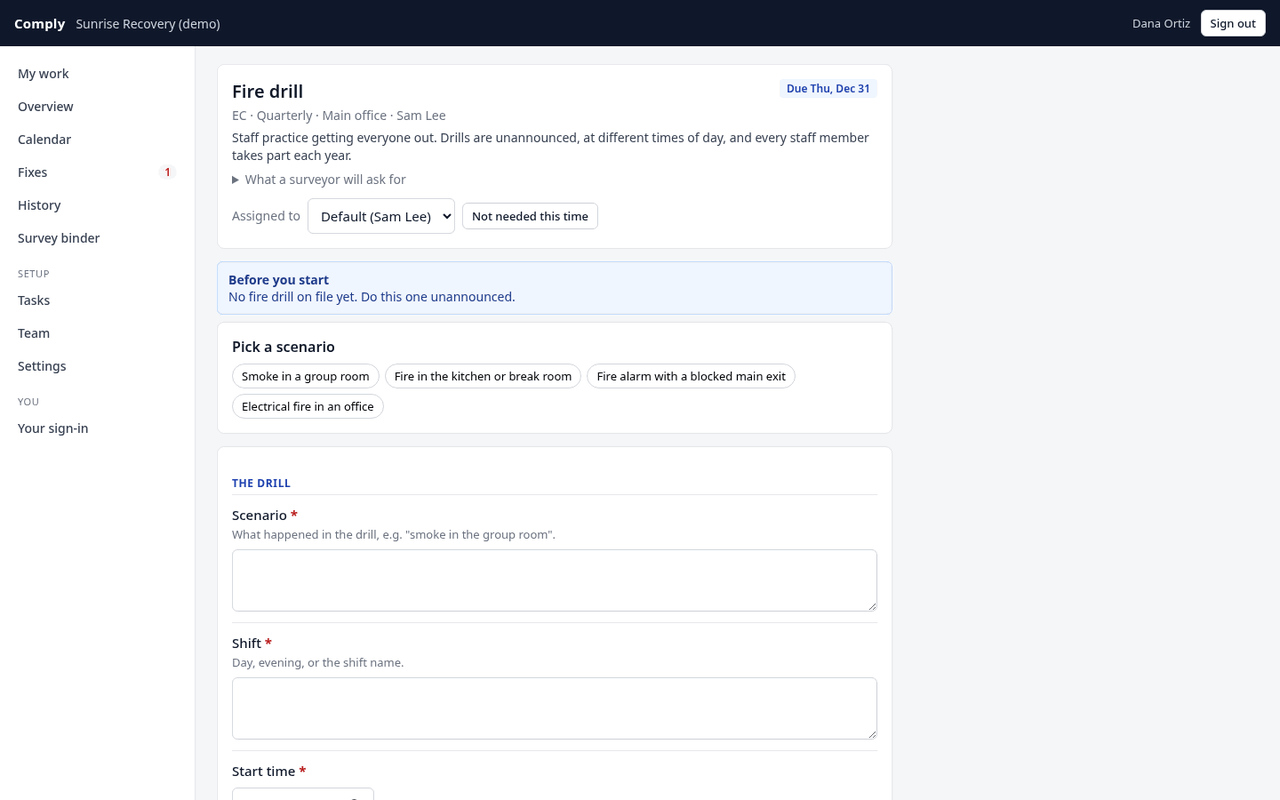
- Before you start, Comply shows when the last drill was, its time and shift, and its scenario, and suggests starting at least an hour earlier or later, on a different shift, with a different scenario. That's a simple way to avoid a pattern.
- When the alarm sounds, tap Start the drill now and a clock starts; tap Everyone is out and the minutes fill in. A real alarm can be logged on the spot from the drill's QR sticker.
- The sign-in sheet needs a photo before the drill can be filed.
- Over 5 minutes to evacuate counts as a problem by default; you can change the goal.
- Each failed line becomes a fix with an owner, due within 2 business days for life-safety problems.
- No "what we'll change"? A fix opens for the written critique, due 5 business days after the drill.
- Records are permanent. A drill done and logged late shows both dates; nothing is backdated or deleted.
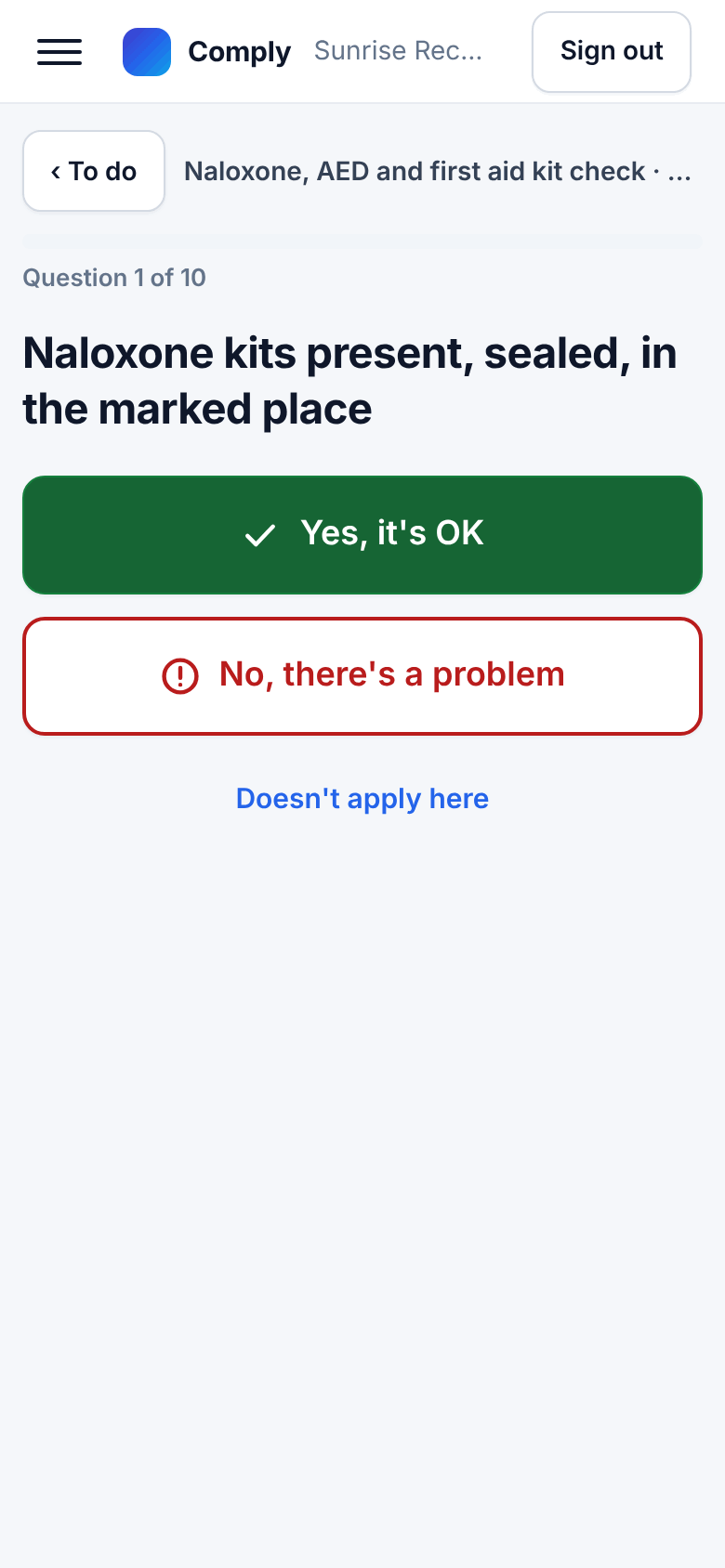
The overview charts each drill's evacuation time against the goal, and the quarterly quality report lists every drill (shift, scenario, minutes, staff, problems, critique written) for the committee to sign.
Never miss a drill or a critique again
Comply schedules drills by building and occupancy, times them on a phone, files the sign-in sheet and opens the fixes. Surveyors get one binder.
Questions
Does a real fire alarm count as a drill?
Ask your accreditor and fire marshal. If it counts, document it exactly like a drill: time, shift, minutes to get out, who was there, a sign-in sheet and a critique. Comply has a line for it ("a false alarm counted as the drill").
We're an outpatient office. Do we really need fire drills?
Very likely, even if the fire code alone wouldn't require them for a small office. Accreditors and state licensing rules usually do, and if your policy manual promises drills, surveyors hold you to it. Check your accreditor's current manual and your state's rules.
How long should an evacuation take?
There isn't one national number for behavioral health. Set a goal in your fire safety plan that fits your building and track it drill by drill. Comply starts with 5 minutes and lets you change it.
Do the drills have to be on different shifts?
In health care and ambulatory health care occupancies, yes: quarterly on each shift. In Texas, residential chemical dependency programs drill each shift at least quarterly. Outpatient programs with evening groups should rotate drills between day and evening so every staff member takes part during the year.
Related guides: the Joint Commission survey checklist, the chart audit checklist, CARF survey prep and the compliance calendar. Or see how Comply works.
Sources
- The Joint Commission, Prepublication requirements issued January 30, 2026 (EC.02.03.03, EP 3: unannounced, unexpected times, varying conditions; alarm and simulated fire conditions).
- The Joint Commission, Joint Commission News, March 2026 (one-hour spacing and 10-day window removed).
- Missouri Hospital Association, The Joint Commission revises fire drill requirements (2026).
- The Joint Commission, Take 5: the environment of care Fire Drill Matrix tool (critiquing each drill).
- The Joint Commission, OPSIG memo on fire drill frequency, 2021 (business occupancy: once every 12 months; health care and ambulatory: quarterly per shift).
- NFPA Journal, Winter 2021 (business occupancy drill thresholds).
- ANSI, Health care occupancy under NFPA 101 (ambulatory health care, health care and business definitions).
- Minnesota Department of Health, Life Safety Code fire drills (NFPA 101 18.7.1.6 / 19.7.1.6: quarterly on each shift).
- Kansas State Fire Marshal, Assisted living and residential board and care fire drill form (six drills a year, bimonthly).
- 26 Tex. Admin. Code §564.1203 (residential programs: drills on each shift at least quarterly).
- North Carolina DHHS, statement of deficiencies, March 2026 (a program cited because its drills were all held at night).
- CARF, behavioral health standards update and CARF accreditation: a facility perspective (2025) (1.H.7 unannounced tests of emergency procedures).
This guide is general information, not legal or fire-code advice. Comply isn't affiliated with or endorsed by The Joint Commission, CARF or NFPA.